Loser #2
|
It is hoped that, by recording the events surrounding Hurricane Katrina's destruction of New Orleans on August 29, 2005, some insight will be gained into the mechanism of disaster. We need to understand how Federal and local government, Republican and Democratic alike, could be so inadequate to a calamity that had been predicted for decades. What emerges from any attempt at doing so is no less than a damning account of corruption, indifference, racism, classism, oppression, ignorance, historical mistrust, and finally a near-total breakdown in all levels of American political and social institutions. If we learn anything from the loss of New Orleans, it is that we have to do better than this. |
Where possible, all times are Central.
T= 0610 Central Daylight Time, August 29, 2005
(Approximate landfall of Katrina's eye)
Humorous graphics are originals made at the time,
by various unknown people, few of whom claimed copyright.
They are best regarded as the Internet version of editorial cartoons.
Precise locations of levee breaches
have been determined from personal examination of aerial photos,
because the various media accounts differ greatly.
Map of New Orleans
1718 - T-287 years:
La Nouvelle-Orléans is founded by Jean-Baptiste Le Moyne de Bienville on one of the few high places near a Native American trading portage along what is now called the Bayou St. John between the Mississippi and Lake Pontchartrain. The original French Quarter aka the Vieux Carre (Old Square) is still one of the few parts of New Orleans that is above sea level. The city grows along a bend in the river, hence the name "Crescent City." Periodic floods, swampy conditions, mosquitoes, yellow fever, and humidity cause health hazards, and the people who die then have to be buried above ground in the city's notorious cemetaries due to water intrusion.
February 6, 1893 - T-107 years, 7 months:
The New Orleans City Council passes Ordinance 7170, authorizing the study of a drainage system for the city. Two years later, engineers design a complicated system of drainage canals and pipes, fed by eight proposed pumping stations. (These are not finished until well into the 1940s.) In 1902, the Drainage Commission merges with the Sewerage and Water Board, and hires the famous Albert Baldwin Wood, who goes on to design the world's largest and most powerful pumps for New Orleans. Some of these are still going strong when Katrina arrives, often holding up better than the newer designs.
The city begins to grow beyond its original boundaries, as marsh land is drained and rendered habitable. By the end of the twentieth century, New Orleans is pumping many millions of gallons out of the city just to keep ground water from filling it up again, let alone to keep rain water from accumulating.
April, 1910 - T-95 years:
New Orleans votes to greatly expand the drainage system and increase the capacity of its pumps. Wood designs several huge screw pumps that can move vast amounts of water. Ultimately his name appears on one of the pumping stations, where it remains to this day.
The city continues to expand its geographical size, ultimately (and over some objections) occupying the very low-lying marshy district that became the Lower Ninth Ward. Unfortunately, the removal of water from these areas causes the ground to dry and subside, making it ever lower as years elapse, and guaranteeing that any floods will be that much deeper. Meanwhile, the continuing construction of levees and floodwalls robs the Delta area to the south of its yearly replenishment of the soil by muddy flood waters, to the point where these marshes have largely vanished by the time of Katrina. This eliminates one important buffer between New Orleans and landfalling Gulf hurricanes.
April 16, 1927 - T-78 years, 4 months, 13 days:
The Great Mississippi Flood of 1927 begins in earnest when 1200 feet of a government levee collapse south of Cairo, IL, flooding 175,000 acres. Tens of thousands of people are displaced. In a grim parallel to Katrina, affluent whites are able to flee flood-prone areas, while poor African Americans are left behind.
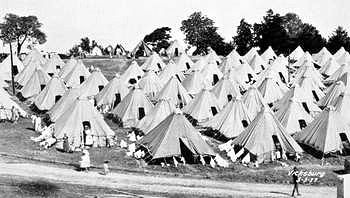
As the weeks go by, flooding cascades down the river, which is swollen to undreamed of levels. In the state of Mississippi, 13,000 displaced African Americans from the Vicksburg region are left stranded in a makeshift tent camp on a levee while river boats are ordered to pick up whites only. The National Guard surrounds the levee to keep anyone from escaping and finding work elsewhere. Instead, many of the African Americans are rounded up at gunpoint and forced to join convicts in work gangs. Stories are told of abuse by guards.
April 29, 1927 - T-78 years, 4 months:
On Good Friday, a 14-inch rain storm hits New Orleans. As water nears the top of the levees, the city of New Orleans chooses to dynamite out a 1500 foot breach of the Poydras Levee in an effort to save its business district. After two charges fail to release very much water, 30 tons of dynamite are set off, as recorded from several angles by newsreel cameras. The resulting tidal wave floods St. Bernard Parish and all the marshes south of the city, creating a pond which lasts to this day. The next day, a levee upstream breaks and lets water out of the river, at which point the dynamiting becomes irrelevant, after all that.
Ultimately, the flood covers 27,000 square miles from 145 levee breaks, thirty feet deep in places. 700,000 people are displaced, 330,000 of them African American. Many of the African Americans wind up in filthy refugee camps scattered throughout the area. There, they are treated like slaves, robbed and sexually assaulted by National Guard members, and denied food unless they wear signs reading "LABORER."

Secretary of Commerce Herbert Hoover comes swaggering into the region, promising all kinds of things and looking quite the hero. Hoover forms a "Colored Advisory Commission" to investigate the camps, but suppresses its report when he fears it might hurt his shot at the presidential nomination. Similar media stories are spiked, and the camps become a permanent part of the unhappy history of Southern race relations.
Hoover's control of publicity spin from the flood does help propel him into the presidency, at which point he quickly abandons the Colored Advisory Commission and ignores its recommendations. Its African American leader bolts to the Democratic Party and supports FDR in the next election. This begins a historic shift in Southern US African American party allegiance (the ones who were allowed to vote, anyway). In a process many fear will happen to New Orleans this time, many displaced African Americans never return to their old homes, resulting in a major migration to the north and west.
Among whites, the perceived Federal indifference to Louisiana helps create the Huey Long political phenomenon. Finally, when the Dust Bowl and Depression add to Hoover's cluelessness and low regard in almost all demographic groups, he goes down in flames as one of the least popular presidents of all time. FDR kicks his butt, and the rest is in the history books.
Some of this is documented, however vaguely, in the Randy Newman song, "Louisiana 1927." This contains the famous refrain, "Six feet of water in the streets of Evangeline."
1956 - T- 49 years:
US Congress allocates money to begin construction of the controversial Mississippi River-Gulf Outlet (MR-GO aka Mister Go), a 66-mile canal that starts in a wide intersection with the Industrial Canal (aka Inner Harbor Navigation Canal) in the Port of New Orleans, and heads eastward through Orleans Parish before slashing straight southeastward through St. Bernard Parish to the deeper water of the Gulf.
Proponents argue that this route will help develop industry and jobs in St. Bernard Parish by providing a deep-water alternative to the shallow and winding Mississippi. Opponents cite studies that the route will be subject to erosion and silting, and will also concentrate hurricane surge right into a funnel-like structure in the middle of the lowest part of New Orleans.
Despite continuing opposition, the canal is completed in 1965. It is never used as much as originally promised. Marshy St. Bernard Parish does not become an industrial zone. Relentless erosion slowly increases the width of the canal from its original 650 feet to a present average closer to 1500. It continues to gain 15 feet more every year.
As predicted, surge is amplified by this waterway, greatly increasing flooding in Katrina, and leaving MR-GO silted up and largely useless. Many will push for its closure. One destroyed house in St. Bernard will have grafitti asking to use the rubble to fill it in.
September 9, 1965 - T-39 years, 11 months, 1.5 weeks:
After doing considerable damage in Florida, Hurricane Betsy makes a second landfall near Grand Isle, LA, which is destroyed. Betsy's path is very much like Katrina's, passing over South Florida, and then re-strengthening in the warm Gulf of Mexico. It reaches Category 4 before weakening somewhat and reaching land as a strong Category 3. In New Orleans, storm surge from lake Pontchartrain breaches a levee near Florida Avenue, flooding the Lower Ninth Ward up to the eaves of some homes.
For the first time, total losses from a hurricane exceed the billion-dollar mark, giving the storm the name "Billion Dollar Betsy." The name is retired and replaced with Blanche. Soon after, the US Army Corps of Engineers begins a program to make all New Orleans levees and flood walls capable of containing a Category 3 hurricane.
May, 1995 - T-10 years, 3 months:
The US Congress authorizes SELA, the US Army Corps of Engineers’ Southeast Louisiana Urban Flood Control project, after a flood kills six people in the region. Almost half a billion is spent by federal and local agencies on storm and hurricane mitigation, but it ultimately goes for nothing when the big one comes, because the last $250 million for critical projects is never appropriated. (New Orleans Times-Picayune)
August, 2000 - T-5 years:
James West and Chris Vaccaro write in USA Today: "A slow-moving Category 3 or any Category 4 or 5 hurricane passing within 20 or 30 miles of New Orleans would be devastating… The storm surge - water pushed into a mound by hurricane winds - would pour over the Pontchartrain levee and flood the city."
October, 2001 - T-3 years, 11 months:
Cover date of Scientific American issue containing "Drowning New Orleans," an article by Mark Fischetti stating the following: "New Orleans is a disaster waiting to happen. The city lies below sea level, in a bowl bordered by levees that fend off Lake Pontchartrain to the north and the Mississippi River to the south and west. And because of a damning confluence of factors, the city is sinking further, putting it at increasing flood risk after even minor storms. Scientists at Louisiana State University (L.S.U.), who have modeled hundreds of possible storm tracks on advanced computers, predict that more than 100,000 people could die."
October 13, 2001 - T-3 years, 10 months, 16 days:
The New Orleans Times-Picayune reports that federal officials are postponing new SELA projects, fearing that "federal budget constraints and the cost of the war on terrorism may create a financial pinch for the program." The Corps of Engineers asks for $80 million, and gets around $57 million. This is not enough to fund the next 12 months’ construction and design work.
March 1, 2002 - T-3 years, 6 months:
FEMA is transferred to the new Department of Homeland Security, losing its Clinton administration cabinet status. First day of DHS authority in natural disasters. Gradually, the priority shifts to dealing with terrorist attacks, and then to making do with ever shrinking budgets.
May 23, 2003 - T-2 years, 3 months, 6 days:
Date appearing on a US Army Corps of Engineers fact sheet about their New Orleans Hurricane Protection project, which is "designed to protect residents between Lake Pontchartrain and the Mississippi River levee from surges in Lake Pontchartrain." Several key vulnerabilities are noted, including sinking levees and the almost certain failure of the 30-some huge pumps which keep the "bowl" dry even when there is no rain or surge. This overdue project includes new levees, new floodwalls, protection for the pumps, and a general upgrade to existing structures, all with a 2015 completion date. It is never funded.
February, 2004 - T-18 months:
After a series of budget cuts, Al Naomi, project manager for the US Army Corps of Engineers, tells New Orleans CityBusiness the following: "The longer we wait without funding, the more we sink. I’ve got at least six levee construction contracts that need to be done to raise the levee protection back to where it should be. Right now I owe my contractors about $5 million. And we’re going to have to pay them interest."
April 24, 2004 - T-16 months, 5 days:
The Times-Picayune reports that "less money is available to the Army Corps of Engineers to build levees and water projects in the Mississippi River valley this year and next year." One engineer is pulled off Louisiana wetlands restoration, an important hurricane protection project, to oversee a $100 million study of wetland restoration in the Tigris-Euphrates valley of Iraq.
April 28, 2004 - T-16 months, 1 day:
Both Louisiana senators meet with Marcus Peacock, associate OMB director for natural resource programs, and John Woodley, Assistant Secretary of the Army for civil engineering. They request more money for environmental restoration and water projects. They do not get it.
June 8, 2004 - T-14 months, 21 days:
Walter Maestri, Emergency Management Chief for Jefferson Parish, tells the New Orleans Times-Picayune, "It appears that the money has been moved in the president’s budget to handle homeland security and the war in Iraq, and I suppose that’s the price we pay. Nobody locally is happy that the levees can’t be finished, and we are doing everything we can to make the case that this is a security issue for us."
June 9, 2004 - T-14 months, 20 days:
FEMA announces a new contract with Innovative Emergency Management, Inc. "a Baton Rouge-based emergency management and homeland security consultant," to "lead the development of a catastrophic hurricane disaster plan for Southeast Louisiana and the City of New Orleans." FEMA doesn't announce that the company is a key GOP campaign donor (Greg Palast blows whistle on this one much later). The first phase is "to complete a functional exercise on a catastrophic hurricane strike in Southeast Louisiana and use results to develop a response and recovery plan."
This exercise takes place a month later.
July 15-23, 2004 - T-13 months:
Approximate dates of "Hurricane Pam," a very comprehensive disaster simulation, mischaracterized in FEMA materials as a "tabletop exercise," in which a carefully simulated slow-moving category three hurricane makes landfall just west of New Orleans. A storm track and parameters furnished by the National Weather Service are used with the Advanced Circulation Model (ADCIRC) to simulate the hurricane. Real-time weather charts and statistics, in standard NWS formats, are furnished the simulation. The goal of this exercise is less to drill emergency personnel than to create a series of recommendations and disaster plans based on what would be learned from the simulation, which would be ultimately adopted as the official state hurricane plan.
For over a week, 250 people from 50 agencies, plus LSU, meet and respond to the simulated disaster. Various unsettlingly prescient conclusions include:
Working groups come up with a comprehensive set of plans. The data goes all the way to FEMA, which begins work on a national plan taking the magnitude of the potential catastrophe into account. More meetings are held.
Some sort of followup activity is scheduled for late 2004 or early 2005, to formalize the final hurricane plan and send it to the state for adoption. This is abruptly cancelled due to lack of funding. The report from Hurricane Pam simply stops short when it gets to this section. The report's adoption into policy is piecemeal, at best.
September 22, 2004 - T-11 months, 7 days:
The Times-Picayune reports that the Bush administration has defunded the studies for a design and budget for finally raising the levees, and ordered the Army Corps of Engineers not to begin any such work.
October, 2004 - T-11 months:
Cover date of a National Geographic containing "Gone With the Water," by Joel K. Bourne, Jr.: "Some 200,000 remained, however-the car-less, the homeless, the aged and infirm... The storm hit Breton Sound with the fury of a nuclear warhead, pushing a deadly storm surge into Lake Pontchartrain. The water crept to the top of the massive berm that holds back the lake and then spilled over.... Thousands drowned in the murky brew that was soon contaminated by sewage and industrial waste. Thousands more who survived the flood later perished from dehydration and disease as they waited to be rescued.... It was the worst natural disaster in the history of the United States."
Early 2005 - T-6 months:
LSU New Orleans Pilot Study report: "A FEMA storm surge model, NOAA's SLOSH model, and now ADCIRC experimental storm surge models based on the most recent levee heights and detailed land elevation data for southern Louisiana, have verified that a slow-moving Category 3 hurricane or greater of these tracks have the potential to flood the New Orleans 'bowl.' Floodwaters have the potential to become hazardous or even flammable by floating diesel fuel, other flammable chemicals, and debris."
The city of New Orleans produces a slick emergency preparedness video for broadcast and DVD distribution. Everyone from the mayor on down is in it. It stresses "car pooling" and the importance of leaving the city if so ordered. Katrina hits before the video can be shown to the public.
June 6, 2005 - T-2 months, 23 days:
New Orleans CityBusiness reports that the New Orleans district of the US Army Corps of Engineers faces a $71.2 million budget reduction for FY 2006. This is the largest single year reduction ever. The district freezes hiring for the first time in 10 years.
Friday, July 29, 5005 - T-1 month, 2 days:
Don Day, a regional emergency officer for the New Orleans, Transportation Department, tells a briefing that the emergency plans developed after "Hurricane Pam" are only 10 per cent complete.
"If you think soup lines in the Depression were long, wait till you see lines [at bus pickup points in New Orleans]. We're at less than 10 percent done with this [...] planning when you consider the buses and the people." (Associated Press)
Tuesday, August 23, 4:00 PM - T-6 days, 2 hours, 10 minutes:
The National Hurricane Center publishes its first advisory on Tropical Depression number 12. This weak tropical cyclone forms in an area of disturbed weather near the Bahamas, when the largely dissipated remains of Tropical Depression 10 merge with a new tropical feature, thereby meriting a new number in the opinion of the NHC. The depression is expected to pass over Florida and into the Gulf of Mexico. Rapid strengthening is expected in the unusually warm water, and so the Bahamas immediately issue a tropical storm warning.
Tuesday, August 23, 10:00 PM - T-5 days, 8 hours, 10 minutes:
NHC issues a tropical storm watch for Florida as the depression continues to organize itself into a strong storm.
Wednesday, August 24, 10:00 AM - T-4 days, 20 hours, 10 minutes:
NHC issues a tropical storm warning and a hurricane watch for southeast Florida as the depression becomes Tropical Storm Katrina out in the Atlantic Ocean.
Wednesday, August 24, 10:00 PM - T-4 days, 8 hours, 10 minutes:
Hurricane warnings go up in southeast Florida as the tropical storm strengthens. NHC advises that "Preparations to protect life and property should be rushed to completion."
Thursday, August 25, 4:00 PM - T-3 days, 14 hours, 10 minutes:
NHC advisory #9 upgrades Katrina to hurricane strength based on observations at sea. The center is located about 15 miles from Fort Lauderdale. Wind picks up in Boca Raton, and power starts to go off.
Thursday, August 25, 6:00 PM - T-3 days, 12 hours, 10 minutes:
Hurricane Katrina makes its first landfall, in Florida between Hallandale Beach and North Miami Beach, as a slow-moving Category 1 hurricane with 80 mph winds. Experienced news reporters and emergency authorities who stay to ride it out all say they are amazed by the storm's ferocity. "That's the biggest Cat 1 I ever saw," is heard more than once. The storm weakens only 10 MPH as it blasts over the low-lying peninsula, emerging into the Gulf of Mexico as a strong tropical storm.
14 people die from hurricane-related causes. One million lose power.
Friday, August 26, 4:00 AM - T- 3 days, 2 hours, 10 minutes:
Katrina quickly regains hurricane strength as it emerges into the Gulf of Mexico.
Friday, Aug 26, 10:00 AM - T-2 Days, 19 hours, 40 minutes:
Katrina is reported to be "rapidly strengthening" in the warm Gulf waters, and it becomes a category 2 "major hurricane." Long range forecasts begin to mention a second landfall somewhere on the Gulf coast between the Florida panhandle and New Orleans. A FEMA memo notes that "New Orleans is of particular concern…"
Friday, August 26 - T-3 days:
Date of press release: "Louisiana Governor Kathleen Blanco (Loser #1) declares a State of Emergency in Louisiana." Blanco, called "The Queen Bee" by many, is a conservative Democrat who likes to tell people to pray a lot.

Date on document named "Proclamation No. 48 KBB 2005," in which (1) a state of emergency is declared in the entire state, (2) the state emergency office is activated, and (3) the state emergency is effective August 26 through September 25.
(Full text is at http://gov.louisiana.gov/Press_Release_detail.asp?id=973.)
This proclamation is communicated with due diligence to state and local authorities and sets in motion the legal framework for a joint disaster response.
Saturday, Aug 27, 9:00 AM - T-1 day, 21 hours, 10 minutes:
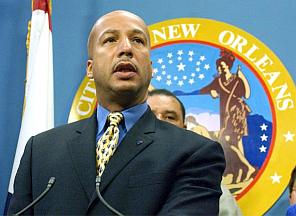
Ray Nagin (Loser #2), a conservative businessman who did a political flip-flop to become the mayor of New Orleans, orders a voluntary evacuation of the city. St. Charles Parish orders a mandatory evacuation. Nagin recommends that parishes nearer the coast comply with the state evacuation plan, so that everyone does not hit the highways at once. He stops short of a mandatory evacuation for the same reason, but privately tells the city attorney to expect one the next day. However, he warns people in the Lower Ninth Ward and Arabi that, "We want you to take this a little more seriously and start moving - right now, as a matter of fact."
Loser #2
As always in a mass evacuation, traffic backs up for many miles. Cars are allowed to leave the city on both sides of highways. Gas is scarce.
Of course, since city transportation is minimal at best, people without cars do not leave at all.
Nagin announces the use of the Superdome as a "shelter of last resort" for those trapped in the city.
For reasons that are still under debate, Homeland Security Secretary Michael Chertoff does not declare an "incident of national significance," an omission which leads to confusion getting the response going. Chertoff is a thin, beady-eyed, vaguely vampiric-appearing man whose veins pop out when he speaks, and whose name is also a Russian word sort of meaning "Satanic." From this point on, Stephanie Miller will refer to him as "Skeletor" on her morning radio show. Months later, Chertoff testifies that he knew the national significance status had actually kicked in as soon as the president declared the emergency. He leaves open the question of whether everyone else knew it.

Loser #5
Saturday, August 27, 10:00 AM - T-1 day, 20 hours, 10 minutes:
A hurricane watch goes up on the Louisiana coast, including New Orleans and Lake Pontchartrain, as Katrina makes Category 3 and continues to strengthen, now filling most of the Gulf of Mexico, causing bad weather from Cuba all the way to Yucatan.
Saturday, Aug 27, 12:00 Noon - T-1 day, 18 hours, 10 minutes:
The National Hurricane Center expands the hurricane watch to Louisiana and Mississippi from east of Morgan City to the Alabama line. Plaquemines Parish orders a mandatory evacuation, and offers bus pickup for people who cannot get to shelters on their own. Jefferson Parish orders mandatory evacuation for Grand isle, Crown Point, Lafitte and Barataria, voluntary elsewhere. St. Bernard Parish recommends voluntary evacuation only, because it does not intend to offer shelters. Two days later, all of St. Bernard Parish will be under water.
Katrina is 400 miles southeast of the coast, as a Category 3 storm. Rapid intensification is predicted.
Saturday, Aug 27 - T-2 days:
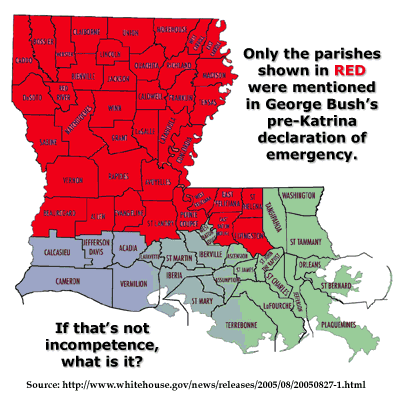
President bush (Loser #3) makes the official written declaration of a state of emergency, and authorizes the Department of Homeland Security and FEMA , "…to coordinate all disaster relief efforts which have the purpose of alleviating the hardship and suffering caused by the emergency on the local population, and to provide appropriate assistance for required emergency measures."
This declaration is limited to a specific list of parishes. The list does NOT include Orleans, St. Bernard, or any other parishes in South Louisiana, which is the most vulnerable (and the most Democratic) region. There is NO federal state of emergency in the southern parishes.
(Full text is at http://www.whitehouse.gov/news/releases/2005/08/20050827-1.html)
Saturday, Aug 27 - T-2 days:
FEMA prepares a slide/PowerPoint presentation to brief unknown White House officials on the situation. It gives full and graphic warning of the catastrophic potential of a major hurricane in New Orleans. FEMA explicitly notes that a Category 4 storm surge "could greatly overtop levees and protective systems." The president, who is on vacation, never sees this. In fact, it is not clear who does, nor whether anyone ever gets the written message afterward. Later on, the people who might know refuse to say anything about it. (ABC News)
Saturday, Aug 27 -T-2 days:
Date of press release: "Governor Blanco asks President to Declare an Emergency for the State of Louisiana due to Hurricane Katrina." In this request, Blanco specifically asks the President to include the southern parishes in his emergency declaration:
This time, the southern parishes are specified:
"The affected areas are all the southeastern parishes including the New Orleans Metropolitan area and the mid state Interstate I-49 corridor and northern parishes along the I-20 corridor that are accepting the thousands of citizens evacuating from the areas expecting to be flooded as a result of Hurricane Katrina."
The following communication is sent to the White House via FEMA:
"Pursuant to 44 CFR § 206.35, I have determined that this incident is of such severity and magnitude that effective response is beyond the capabilities of the State and affected local governments, and that supplementary Federal assistance is necessary to save lives, protect property, public health, and safety, or to lessen or avert the threat of a disaster. I am specifically requesting emergency protective measures, direct Federal Assistance, Individual and Household Program (IHP) assistance, Special Needs Program assistance, and debris removal."
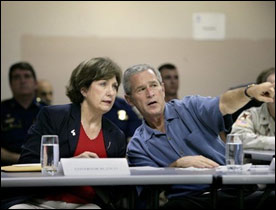
Which follows is a period of miscommunication which creates the oft-referenced, and now infamous, "24-hour delay," in which the president and the governor both seem to be waiting for the other one to give in. This apparent pissing contest will figure highly in the subsequent "Blame Game," as so termed by the bush administration and picked up by the right wing echo chamber as an attempt to dismiss all the outcry as partisan politics as usual. As this "game" progresses, the governor will accuse the president of attempting to take away state sovereignty by granting Federal troops and agents unprecedented powers approaching martial law. The president will say that the governor did not understand the situation.
Loser #1 with Loser #3
(Full text at http://gov.louisiana.gov/Press_Release_detail.asp?id=976)
The president issues statements on Florida, Alabama, and Mississippi, but not Louisiana.
Saturday, Aug 27 - T-2 days:
Max Mayfield, Director of the National Hurricane Center, examines the increasingly unsettling weather predictions, and makes a number of phone calls to local, state, and federal officials with a warning that the worst case is about to materialize in New Orleans: "This is really scary. This is not a test… This is the real thing."
Saturday, Aug 27 - T-2 days:
Ivor van Heerden, deputy director of the LSU Hurricane Center, warns media that "this is a worst-case scenario and everybody needs to recognize it." He notes that levees are in major danger of collapse, and that chemical contamination from the "Cancer Alley" plants near the Mississippi could render flood waters toxic. Van Heerdan, a controversial figure given to dire scenarios involving such dangers as fire ants, begins making the rounds of news media. He gets it pretty much right, ants or no ants.
Saturday, Aug 27, 10:00 PM - T-1 day, 8 hours, 10 minutes:
NHC issues a hurricane warning for "The North Central Gulf Coast from Morgan City, Louisiana eastward to the Alabama/Florida border...including the city of New Orleans and Lake Pontchartrain." The advisory continues that, "A hurricane warning means that hurricane conditions are expected within the warning area within the next 24 hours. Preparations to protect life and property should be rushed to completion."
Sunday, Aug. 28, 12:00 Midnight - T-1 day, 6 hours, 10 minutes:
Approximately 30 hours before landfall. This is the time recommended in the Louisiana emergency plan for New Orleans to begin evacuating in earnest. Nagin, who has already recommended people think seriously of leaving, does not order a mandatory evacuation for another 9 hours. As the story goes, he is consulting with anxious tourist businesses and attorneys about the potential for liability if he empties out the city.
Sunday, Aug. 28, 1:00 AM - T-1 day, 5 hours, 10 minutes:
NHC "Hurricane Katrina Special Advisory Number 20" raises Katrina to Category 4, with winds of 145 mph.
Sunday, August 28, 7:00 AM - T-23 hours, 10 minutes:
"Hurricane Katrina Special Advisory Number 22" raises Katrina to category 5, with "potentially catastrophic" 175-mph winds and 18-foot surge, higher than the levees around the subsiding New Orleans. Max Mayfield participates in a video conference call to the president, still on vacation in Crawford, Texas.
Sunday, August 28, 9:30 AM - T-20 hours, 30 minutes:
The end of a secure-video teleconference which also included Brown, Chertoff, Bush, Mayfield, Blanco, and many other officials. Later examination of videos and transcripts of this teleconference shows that the possibility of catastrophic levee breaches was clearly discussed, despite the initial assertions right after the storm by Bush and Chertoff that nobody had anticipated such an event. The video also shows concern about the evacuations. Brown expresses fears that the Superdome roof might collapse, and that DMAT medical resources are inadequate. Mayfield predicts one of the "top 10 or 15" worst disasters in US history. Col. Jeff Smith, Louisiana's emergency preparedness deputy director, expresses mistaken confidence that, "a lot of the planning FEMA has done with us the past year has really paid off."
Nagin, who has gotten an earful of what's about to happen, finally makes the voluntary evacuation of New Orleans mandatory. He declares, "I wish I had better news, but we're facing the storm most of us have feared. This is very serious. This is going to be an unprecedented event."
Residents are instructed to pack up and leave as soon as possible. The time left is approximately half the 48 hours that emergency planners had estimated would be required for any effective evacuation of the city. Vaguely defined, but never funded or finalized, emergency plans deteriorate into chaos. Police, school personnel, and other city employees flee town with everyone else, leaving buses standing unused. A few transit district buses do take people from neighborhoods to the Superdome, which quickly exceeds its planned capacity, meaning that the three days' supply of MREs becomes far less than that.
As predicted in the Hurricane Pam simulation, the favored classes (largely Caucasian) pile into the family SUVs and blow town. The underclasses (mostly African American) pretty much don't. An unknown number of people, perhaps 110,000, remains in New Orleans.
Sunday, August 28, 10:00 AM - T-20 hours:
"Hurricane Katrina Special Advisory Number 23" raises the expected surge to 18-22 feet, well above the Pontchartrain levees, and inches below the ones along the Mississippi River.
At some point in this general time frame, and per recommendations made after "Hurricane Pam," the Louisiana Department of Wildlife and Fisheries requests 300 rubber rafts from FEMA for later use by search-and-rescue personnel. The request is turned down. (Testimony before a Congressional committee hearing, 1/06)
Sunday, August 28, 11:31 AM - T-18 hours, 39 minutes:
President's address, from vacation ranch in Crawford, TX, contains 203 words about Katrina and 819 about Iraq. At the next ranch over, several thousand war protesters gather for the final Sunday at the antiwar Camp Casey.
Sunday, August 28, 4:00 PM - T-14 hours, 10 minutes:
NHC Advisory #24 relays an aircraft observation of Katrina's central pressure at an ear-popping 902 millibars, or 26.64 inches. This is as low as Katrina goes. While it is very low, Wilma will later manage to make it all the way down to 882 millibars, lowest ever recorded in the Atlantic. Satellite photos of Katrina are awesome, showing a fully developed cyclone with a large, deep, "stadium effect" eye, and an enormous wind field already stretching clear from Baton Rouge to Central America. This one is a monster.

Katrina is now 180 miles south of the Mississippi Delta.
Sunday, August 28, 4:13 PM - T-13 hours, 57 minutes:
US National Weather Service, New Orleans releases a very scary advisory containing such language as: "Most of the area will be uninhabitable for weeks... Perhaps longer.... Partial to complete wall and roof failure is expected.... Airborne debris will be widespread, and may include heavy items such as household appliances and even light vehicles. Persons, pets, and livestock exposed to the winds will face certain death... Power outages will last for weeks... Water shortages will make human suffering incredible by modern standards."
AP predicts: "an environmental disaster of biblical proportions , one that could leave more than 1 million people homeless… a vast cesspool tainted with toxic chemicals, human waste and even coffins released…from the city's legendary cemeteries."
A week and a half later, Rick Santorum will call the three days of various dire predictions coming from the National Weather Service "not sufficient" warning.
Sunday, August 28, 4:46 PM - T-13 hours, 24 minutes:
Time stamp on e-mail from Marty Bahamonde, FEMA regional director for New England, to David Passey, FEMA Region 6 Director. Bahamonde is caught in New Orleans, and is therefore the sole FEMA rep in the city. Had he made it out, there would have been no one. E-mail says:
"Issues developing at the Superdome. 2000 already in and more standing in line. ... The medical staff at the dome says they will run out of oxygen in about 2 hours and are looking for alternative oxygen."
Sunday, August 28, 5:28 PM - T-12 hours, 42 minutes:
E-mail from Bahamonde to Deborah Wing, FEMA response specialist, regarding the Superdome:
"Everyone is soaked. This is going to get ugly real fast."
Sunday, August 28, 7:16 PM - T-10 hours, 54 minutes:
Group e-mail from Passey:
"The current population at the Superdome in New Orleans is 25,000. That's a large crowd during a normal event. Among the shelter population are 400 special needs evacuees and 45-50 sick individuals who require hospitalization. The on-hand oxygen supply will likely run out in the next few hours. According to the ... [health and medical services] folks, the local health officials have struggled to put meaningful resource requests together."
Sunday, August 28, 8:30 PM - T-9 hours, 40 minutes:
Amtrak moves an empty train out of New Orleans to a safer area. A phone call is made to authorities offering space for 1000 people on this train for evacuation. "We offered the city the opportunity to take evacuees out of harm's way…The city declined," said Amtrak spokesman Cliff Black. Nagin later claims that no such call was ever received by his office.
Sunday, August 28, 8:30 PM - T-9 hours, 40 minutes:
E-mail from Passey to Bahamonde:
"Our intel is that neither the ... [Oklahoma DMAT medical team] nor the public health officers staged in Memphis will make it to the Superdome tonight. Oxygen supply issue has not been solved yet either."
Sunday, August 28, 10:45 PM - T-7 hours, 25 minutes:
Heroic WWL-TV, the New Orleans CBS affiliate which has been in 24-hour coverage since Saturday, evacuates its New Orleans studio for a site at the LSU Journalism School in Baton Rouge. Sites at the transmitter in Gretna, and at WLPB in Baton Rouge, are also used. The station cobbles together a satellite and microwave link to feed program. It stays on the air, with a simple but informative and very immediate 24/7 emergency coverage. With only minor breaks at night, WWL-TV keeps this up for nine days. Its blog, along with that of the Times-Picayune, becomes a major information resource.
AM radio WWL also does its usual heroic job, once again becoming the station of record for a Gulf hurricane. Everyone calls the station, including storm victims in mortal danger, and even Ray Nagin, who sums up the entire struggle with FEMA in his famous declaration, "Pardon my French, but I'm pissed!" WWL teams up with competitor Clear Channel for a "United Radio" broadcast, which is relayed by various other stations, including powerful WSHB on shortwave with a global reach. Along with the webcast, this allows thousands of people throughout the world to follow the hurricane literally through hell and high water, not to mention the destruction of the studio. Two days later, with water rising in the newsroom, production finally relocates to Baton Rouge.
Both stations' transmitters, in storm-hardened buildings, manage to find enough generator fuel to stay on the air.
Monday, August 29, 2:00 AM - T-4 hours, 10 minutes:
NHC Intermediate Advisory #25B has some good news and some bad news. Good news is that Katrina, which had been heading straight for New Orleans, was beginning to wobble to the east, taking the city out of the eye wall and the deadly northeast quadrant. Good news is also that Katrina has dropped a bit, down to a strong Category 4. Bad news is that Category 4 is like being hit by a semi instead of a train, and that hurricane force winds have already started in New Orleans, with the storm still 130 miles away.
The Department of Homeland Security sends a report to the White House Situation Room, with a warning that flooding "could leave the New Orleans metro area submerged for weeks or months," and also that damage would run into the tens of billions. This makes it rather odd that later they will all say they had no dream such a thing could happen. (ABC News)
Monday, August 29, 3:45 AM - T-2 hours, 25 minutes:
Jefferson Parish emergency manager Walter Maestri reports from the operations center that he has no reports of wind damage or tidal surge problems, though he also notes that the pumping of water from New Orleans is raising the levels of drainage canals to dangerous stages.
Monday, August 29, 4:45 AM - T-1 hour, 25 minutes:
Kenner, LA pulls police off the streets as wind gusts increase. Eye still just offshore.
Monday, August 29, app. 5:00 AM - App. T-1 hour
Even before the eye passes east of New Orleans, the first surge coming out of Lake Borgne hits St. Bernard Parish to the southeast. As feared, it blasts into the MR-GO, quickly blowing out the levee for around 90 per cent of its length, and sealing St. Bernard's watery doom.
Back in New Orleans, a separate flooding incident is reported in the northeast, where water begins to top low walls that were never improved after the money ran out in 1965. [Satellite photos show huge sections of this wall missing, and one entire housing project simply gone. -Hugh '06]
By this point three of the four levees around St. Bernard Parish southeast of New Orleans have failed in multiple locations, flooding the entire parish. (The other one goes later.) A giant wave not unlike last year's tsunami rolls across the entire region. At St. Rita's nursing home in Chalmette, where they have decided to ride out the storm rather than try to move frail patients, a rumbling sound is heard. Immediately afterward, the building is hit by the wave, which quickly floods the outside up to the roof line. Water pours in through ventilation holes, filling the building. 25 of 60 patients are rescued. 5 of these die soon after. The rapidly decomposing bodies of the other 35 are discovered days later, when authorities search the building and adjoining grounds. In this and other parts of the storm area, the total of dead hospital and nursing home patients ultimately reaches 200.
In Meraux, storage tanks at the Murphy Oil refinery rupture, spilling 1.1 million gallons.
The westward-flowing surge is concentrated by a natural funnel which connects several waterways from both lakes with a ship turning basin intersecting the 5.5-mile Industrial Canal, aka the Inner Harbor Navigation Canal. This channel links Lake Pontchartrain with the Mississippi River using locks at the river (southern) end to compensate for the different water levels.
This concentrated surge builds explosively in the Industrial Canal, smashing into the closed locks, where it has nowhere to go. It instantly rises in the canal, quickly overtopping the aging concrete flood walls set into the earthen levees. Flooding begins on both sides of the canal as water pours over the banks. The city's pumps begin to fail due to power disruption (no backup generators) and water intrusion into unprotected equipment, just as predicted in the request for the improvements that were never funded.
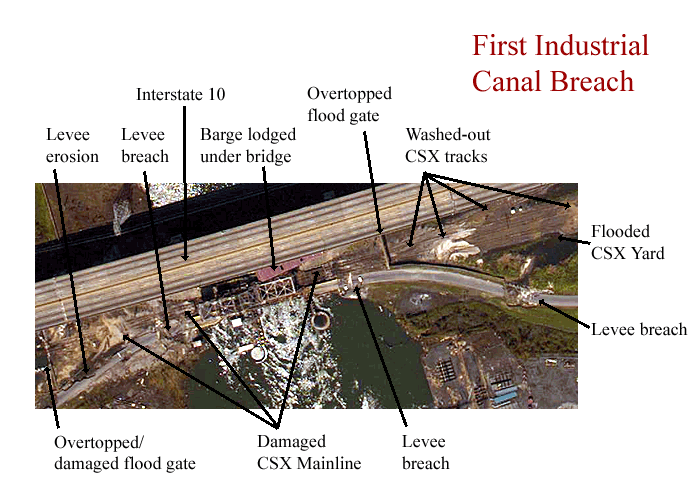
At the north end of the canal, a power station floods. Drainage canals along the Interstate 10 are overwhelmed, and a barge washes into the bridge where the highway crosses the canal to the north of the turning basin.
Just south of this highway, where the CSX railroad crosses the canal in a 2-track bridge, the first real New Orleans levee breach takes place, around 5 AM. Water sloshing back up the canal overtops low flood walls, and spills through gates damaged by a previous train derailment onto the tracks. Temporary sandbags (if any - media accounts differ) wash away, and water begins to run quickly into Gentilly and East New Orleans, worsening the existing flood. Farther south, a flood wall begins to fail in multiple places. By the time the satellite pictures are taken a couple of days later, the water has receded, leaving a damaged mess where a functioning railroad bridge had been, and to the south a completely cleared out area which had been a neighborhood. At least three levee breaches are visible, though none as serious as what is about to happen elsewhere on this canal.
Monday, August 29, 6:10 AM - ZERO TIME
"Hurricane Katrina Intermediate Advisory Number 26A" reports the now rapidly weakening Katrina making landfall SE of New Orleans on the Louisiana coast as a strong Category 4 storm [later officially downgraded to a Category 3], with 145 mph winds [later lowered to 127] and predicted surge of 28 feet. NHC warns that "some levees in the greater New Orleans area could be overtopped." In fact, this is already happening in a few places.
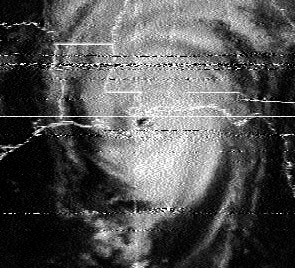
This grainy, static-y satellite picture is the last radiofacsimile broadcast of Katrina from NMG, the US Coast Guard's New Orleans Communication Station. It shows the hurricane's eye just to the east, pretty much as close as it ever got to the station. This transmitter went off the air soon afterward. Although it had only minor damage, it did not come back on the air for around three weeks.
Monday, August 29, 6:50 AM - T+40 minutes:
The second major levee breach occurs on the Industrial Canal complex. 150 feet of the undermined eastern flood wall fail just below the Florida Avenue bridge, at the north end of the now-submerged Surekote Road, a couple of blocks west of the dead end of Tennessee Street up against another levee. Water pours into a low-lying section of the Lower Ninth Ward, a disadvantaged, African American district in a known flood area. Across the canal, the huge Florida Avenue Pumping Station is overwhelmed, then damaged, and finally inoperative.

Monday, August 29, app, 7:00 AM - T+ app. 1 hour
Ray Nagin tells a radio interview that water is breaching the Industrial Canal floodwall into the Ninth Ward, and that some flooding has occurred east of the Industrial Canal. He reports that the Florida Avenue pumping station next to the levee breach has failed, and that he has unconfirmed messages regarding people trapped on roofs. (People are confirmed on roofs in St. Bernard Parish.)
Other reports: city 911 system inoperative. Charity Hospital losing windows and on emergency power. The pedestrian walkway at this hospital has NOT collapsed, previous reports notwithstanding. Four pumps knocked out by flooding, one restored to partial service. Reports of groans in the Superdome when the power fails around 7 AM.
Monday, August 29, 7:00 AM - T+50 minutes:
Bahamonde, near the Superdome, is aware only that pumps are failing. He reports, in error, that there is "no widespread flooding yet."
Monday, August 29, 7:19 AM - T+1 hour, 9 minutes:
At the most critical moment of the worst U.S. disaster in any of our lifetimes, Cindy Taylor sends the following remarkable e-mail to FEMA head Michael Brown (Loser #4):
Subject: I know it's early but...
My eyes must certainly be deceiving me. You look fabulous - and I'm not talking about the makeup!
Monday, August 29, 7:30 AM - T+1 hour, 20 minutes:
Approximate time stamps on e-mails which show the first reports of the levee breaches reaching Washington. While vacationing top officials gallivant around the country doing photo ops and trying to minimize the Cindy Sheehan political damage, staffers at the White House and 28 executive agencies begin to learn the seriousness of the situation.
Monday, August 29, 7:45 AM - T+1 hour, 35 minutes:
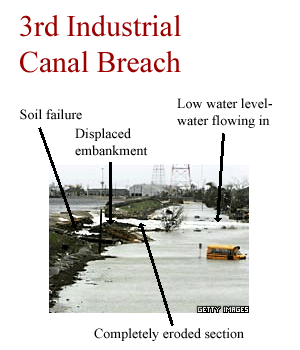
While Brown's staff is dazzled by his fashion prowess, the third and worst breach occurs on the Industrial Canal. This time it is at the southern end of Surekote Road, just south of the previous break, and north of another drawbridge, where Claiborne Avenue crosses over. Again, the flood wall's insufficently deep underground pilings begin to undermine and fail.
With an explosive concussion described as sounding like a huge bomb, 800 feet of the levee burst open. Huge cement walls are thrown aside, as if kicked by an unseen giant. Earthen embankments the size of small hills are simply lifted off their rapidly liquifying bases. A tsunami-like wall of water blasts into the Ninth Ward, simply removing everything in its path. Aging but well-built shotgun shacks are floated away in one piece like boats, to wind up in someone else's neighborhood. A surprising number of blocks nearest the breach look like a less-burned Hiroshima. Everything is gone.
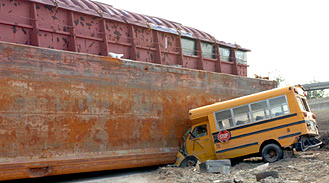
The giant current yanks on the moorings of several huge, very heavy, barges in the canal. One bright red, 195-foot, oil barge snaps free and sails right through the new breach into the Lower Ninth Ward. With another explosive shock wave, this barge thumps into the muddy bottom, knocks over a power line, reduces several houses to instant kindling wood, and finally comes to rest near the canal. A school bus winds up against the barge, in a vaguely obscene, nose-forward position more resembling a breast-feeding kitten or a tiny pilot fish servicing a shark.
Later on, there is unproveable speculation that the barge hit might not have been an accident, but a plan to clear out the low-income African-American neighborhood for land development. This theory is given traction by a historical accounts of racist behavior in the Great 1927 Flood, but discounted by US Army engineers who say the barge floated across. Days later, giant cranes remove other barges from the supports of a bridge, where they threaten the integrity of the structure. This one, however, remains right where it is for another six months, before finally being cut up and taken to a warehouse.
The flooding of New Orleans is now well under way. Thousands are trapped in attics and on roofs, and the storm has hours to go. Ultimate flood depth tops out around 12-15 feet in places.
Monday, August 29, 7:52 AM - T+1 hour, 42 minutes:
As hell and high water strike an American city, the head of the most important Federal disaster agency sends the following reply to Cindy Taylor's e-mail:
From: Brown, Michael D
Subject: Re: I know it's early but...I got it at Nordstrom's. E-mail McBride and make sure she knows! Are you proud of me? Can I quit now? Can I go home?
Monday, August 29, 8:46 AM - T+2 hours, 36 minutes:
As an American city flies into pieces all around him, Marty Bahamonde sends the following e-mail to Brown, Taylor, and several others:
From: Brown, Michael D
Subject: Re: New Orleans updateNow I am going to vomit, laughing and swaying simultaneously is not recommended. And no, I am having that same eyewall problem right now.
--------------------------
Sent from my BlackBerry Wireless Handheld
Monday, August 29, 8:51 AM - T+2 hours, 41 minutes:
As thousands of people in an American city fight to survive, Brown answers Bahamonde's e-mail as follows:
From: Brown, Michael D
Subject: Re: New Orleans updateIf you'll look at my lovely FEMA attire you'll really vomit. I ama fashion god.

Loser #4 (left)
Monday, August 29 - morning - T+approximately 2-3 hours:
The flood reaches the Louisiana National Guard headquarters in Jackson Barracks (named for Andrew Jackson, winner of the nearby Battle of New Orleans in the War of 1812). Despite the site's known flooding danger, lying as it does at the southeast end of the Lower Ninth Ward, a sizeable contingent of troops have been hunkered down there, awaiting duty in the post-hurricane phase. Instead, they have to save themselves, as the building fills up with water. National Guard trucks are also lost in the flood, and communications equipment is destroyed. The Guard's response is delayed 24 hours, and its effectiveness is badly compromised. Some of the Guard make it to the Superdome, at least increasing the military presence there in the crazy hours to come.
Monday, August 29 - morning - T+approximately 2-3 hours:
Bush finally includes the southern Louisiana parishes in a "Statement on Federal Disaster Assistance for Louisiana." Federal assistance and special disaster funding are finally legally authorized in the southern parishes. The "24-hour delay" ends. Of course, now the hurricane has made landfall.
(Full text at http://www.whitehouse.gov/news/releases/2005/08/20050829-2.html)
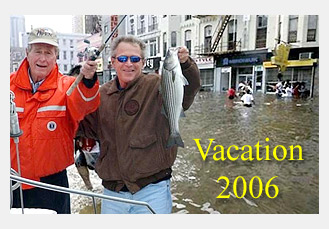
Monday, August 29, 9:00 AM - T+2 hours, 50 minutes
Reports that water is 6-8 feet deep in the Lower Ninth Ward. Water over a floodwall near the Lakefront Airport next to the giant levees running along Lake Pontchartrain. For some reason, this wall is lower than the rest of the lake's levee system, which neither overtops nor breaches. Water floods into another area west of the Industrial Canal.
Monday, August 29, 9:09 AM - T+2 hours, 59 minutes:
Report by ham radio to the National Hurricane Center that the Superdome roof is losing pieces. Indeed, it is soon evident that 2/3 of the roof's protective plastic covering has been blown away, and of course the rain is coming in through what appear to be two large hatch covers removed by the storm. However, later examination shows no major structural damage to the roof.
Peak of the surge in the canals.
Monday, August 29, 9:30 AM - T+3 hours, 20 minutes:
An eastern section of the wall on the London Avenue Canal fails near Mirabeau Road. Giant cement sections are spread apart, or snapped off their steel and concrete supports. Undermined earthen levees are lifted and moved, largely intact, for 30 feet in places. Water lifts homes off foundations, moving one of them 120 feet, completely clearing out an area alongside the levee. Homes farther away are flooded up to the eaves, for block after block.

Monday, August 29 - 9:36 AM - T+ 3 hours, 26 minutes:
Matthew Green, at the National Hurricane Center in FL, sends the following e-mail to Michael Lowder of FEMA:
Subject: Re: superdome
Report that the levee in Arabi has failed.. next to the industrial canal
Monday, August 29 - 9:50 AM - T+ 3 hours, 40 minutes:
Matthew Green sends the following e-mail to Edward Buikema, and cc's Michael Lowder:
Subject: RE: information
from WWL TV
..A LEVEE BREACH OCCURRED ALONG THE INDUSTRIAL CANAL AT TENNESE STREET. 3 TO 8 FEET OF WATER IS EXPECTED DUE TO THE BREACH…LOCATIONS IN THE WARNING INCLUDE BUT ARE NOT LIMITED TO ARABI AND 9TH WARD OF NEW ORLEANS.
Monday, August 29, approximately 10:00 AM - T+ approximately 4 hours:
Wind shifts to the west as the eye moves northward from New Orleans. Surge recedes in the canals, but rises quickly in Lake Pontchartrain. Water picks up enormous concrete roadway slabs on the Interstate 10 Twin Bridges between New Orleans and Slidell, and drops them into the water like little rocks.
Al Naomi, USACE project manager, receives word that the rising lake has topped a low flood barrier near the marina and yacht club, where the lake meets the north end of the 17th Street Canal dividing New Orleans from Metarie, LA. Buildings on the lake front are smashed into kindling wood, which accumulates near the "hurricane proof" Hammond Highway bridge.
At some unknown time between 10:00 and 10:30, the levee and flood wall along the eastern (New Orleans) side of the canal, adjacent to Bellaire Road and south of the Hammond bridge, are undermined. The situation is not helped by the uprooting of a large oak tree by wind, which tears a large hole in the muddy ground.
Flood walls in this stretch of the canal are not overtopped. In fact, Katrina never even reaches the rated category 3 conditions in this area, and the high water mark is two feet below the top of the wall. However, the shallow support pilings fail once more, blowing out six hundred feet of the canal with another explosive shock wave, this one strong enough to knock out the walls of nearby homes. Engineers marvel at the extreme damage to the reinforced concrete flood walls, which are spread apart, undermined, and/or snapped from their supports, and then thrown aside like nothing, with the pieces vanishing below the murky water. A long stretch of the earth embankment is lifted aside by the water. It winds up, grass and all, around 45 feet east of where it had been.
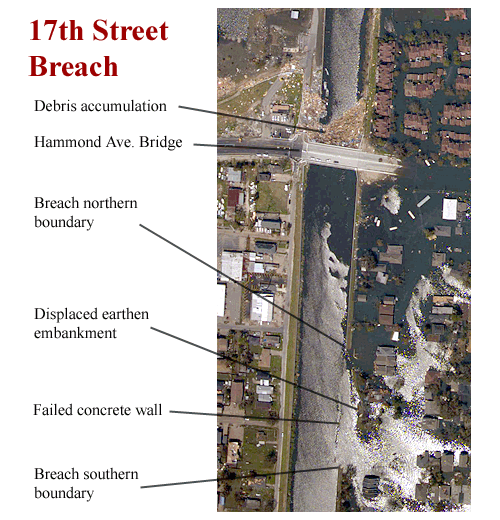
Water now gushes into the northwestern portions of New Orleans, through breaches in the high walls, and around bridges and low spots never raised far enough. Huge areas of "the bowl" fill up, slowly but steadily, mile after mile, creeping across the city all night long, surprising people who have gone to sleep in dry homes. Freeways become islands, with offramps to nowhere. Hospitals become accessible only by helicopter - when it's safe enough to fly them. The water level in the city does not equalize with Lake Pontchartrain for another two days, ultimately leaving much of it 6-9 feet deep.
Later, people will wonder why these levees did so badly when they never reached their design limits. Many web sites carry the same uncorroborated report that burn marks and residues of two different military explosives were found on the cement by a diver, supposed evidence that the New Orleans side was blown up to save Metarie, a more affluent area. A similar story becomes something of a folk wisdom in the Lower Ninth Ward, along with the barge theory. This, as we have noted twice now, receives credence from the historic dynamiting of levees in 1927.
Another, later, theory suggests corruption by the contractors building the levee. However the text of an earlier lawsuit surfaces, showing that problems were known to everyone involved. All agree that the levees were probably never built to the design spec in the first place, and could not even withstand the specified category 3 storm, a condition that the 17th Street Canal never reached in any case. The soil of the earthen banks was not sufficient to hold the walls in place, and it failed. The steel pilings were not driven deep enough. One must indeed conclude that the 17th Street Canal was defective, that the authorities knew it was defective, and that when it failed they acted surprised.
Monday, August 29, 10:12 AM - T+4 hours, 2 minutes:
In e-mail, FEMA's Michael Heath relays the following information from Marty Bahamonde to Michael Brown:
-Severe flooding on the St. Bernard/Orleans parish line. Police report water level up to second floor of two story houses. People are trapped in attics.
-Pumps starting to fail. The city has now confirmed four pumps are off line.
-Windows and parts of the east side of the Amaco Building blown out.
-New Orleans shopping center (next to superdome) destroyed.
-Windows and parts of the East side of the Hyatt Hotel have been blown out. Furniture is blowing out of the hotel.
-Top floors of the Entergy building have been blown out.
-Area around the Superdome is beginning to flood.
Monday, August 29, 10:13 AM - T+4 hours, 3 minutes:
Time stamp (11:13 Eastern) on a "Katrina Spot Report" inside the White House Homeland Security Council. It notes the following:
"Flooding is significant throughout the region and a levee in New Orleans has reportedly been breached sending 6-8 feet of water throughout the 9th ward area of the city."
So much for the excuse that no one in Washington knew.
Monday, August 29, 10:30 AM - T+4 hours, 20 minutes:
The west side of the London Avenue Canal fails, just south of Robert E. Lee Boulevard, with yet another explosive shock wave, and a massive displacement of soil beneath the wall. This releases an 8-foot wave into the adjoining neighborhood. The City Park fills up like a bucket, leaving only the tops of stadium grandstands poking out like oval islands in a huge lake. There are now five major levee breaches in the city of New Orleans, one or two minor ones, and a dozen total.

Monday, August 29, 11:00 AM - T+4 hours, 50 minutes:
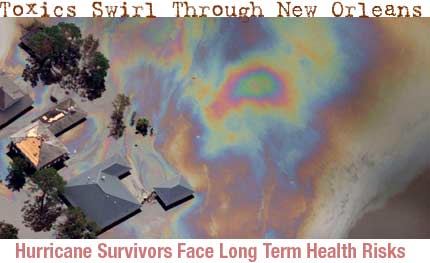
"Hurricane Katrina Advisory Number 27" puts the rapidly collapsing eye 35 miles east of New Orleans. Every window on one side of the nearby Hyatt hotel is blown out. NASA's expensive Michoud Assembly Facility, which does work on the Space Shuttle boosters, is damaged. Water covers a stretch of Interstate 10 near the Industrial Canal. Toxic flood waters invade the compromised city water system, requiring that it be boiled before drinking. Pregnant women are warned that they cannot even drink the boiled water. Ultimately, it becomes dangerous even to bathe in the stuff. Meanwhile, the water pressure fails, backing up rest rooms in the Superdome.
The already heavily damaged Southern Yacht Club on Lake Ponchartrain (near the first 17th Street Canal breach) is now on fire. There are no resources to put it out, and no way to get there short of fire boat, so it burns for hours and falls into the water.
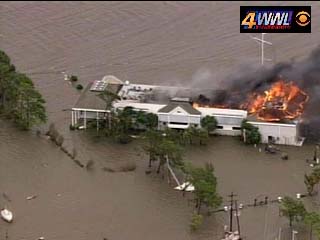
Bahamonde e-mails FEMA about "water flow bad." No response.
On the other (stronger) side of the eye, in Mississippi, whole neighborhoods near the water are simply gone. Huge piles of wood and debris mark the limits of the surge. Floating casinos in Biloxi are now resting on dry land far from the water, and 80% of that city is in ruins. Nearby Keesler Air Force Base is so badly damaged that "Hurricane Hunter" aircraft have to use a different home base for the remainder of the season.

Large expanses of marshland south of New Orleans are now part of the Gulf of Mexico. In the city, ham radio reports of people trapped on roofs are passed to the Coast Guard, which is the only agency with the assets right where they're needed. USCG Vice Admiral Thad W. Allen (Good Guy #1) becomes seemingly ubiquitous in this period, when everyone else seems frozen in the headlights. The Guard begins making hundreds of rescues.
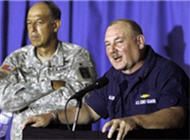
Good Guy #1 (right); Good Guy #2 (left)
Monday, August 29, approximately 11:00 AM - T+ approximately 5 hours:
FEMA director Michael Brown sends his boss Michael Chertoff a memo requesting an additional 1,000 rescue workers from the Department of Homeland Security "within 48 hours" and 2,000 more within seven days. He proposes sending the workers first for training in Georgia or Florida, then to the disaster area "when conditions are safe." Among the duties of the workers, Brown proposes, is to "convey a positive image of disaster operations to government officials, community organizations and the general public." Soon after, experienced fire fighters, who could be rescuing people, are wasting their time in Atlanta being trained in public relations.
Monday, August 29, 11:06 AM - T+4 hours, 56 minutes:
President Bush promotes his Medicare plan to a carefully chosen audience in the desert of El Mirage, AZ. He devotes 156 words to the hurricane in a 44-minute speech and dialogue.
Monday, August 29, 11:56 AM - T+5 hours, 36 minutes:
Michael Heath relays the following e-mail message from Bahamonde to Michael Lowder:
FYI…
From Marty. He has been trying to reach Lokey.
New Orleans FD is reporting a 20 foot wide breach on the lake Pontchartrain side levee. The area is lakeshore Blvd and 17th Street.
-----------------------------
Sent from my Blackberry Wireless Handheld
Monday, August 29, 11:57 AM - T+5 hours, 47 minutes:
Michael Lowder relays the report of the levee breach in Heath/Bahamonde's e-mail to Michael Brown, labeled, "Not sure if you have this…"
Monday, August 29, 12:00 PM - T+5 hours, 50 minutes:
Beginning of a mysterious 40-minute conference call, in which unnamed emergency managers, probably including FEMA, discussed the evolving Katrina situation in New Orleans.
The call is mysterious because no record of it exists. It is conspicuous by its absence from recordings later turned over to investigating commitees. No one knows what happened to the recording, if it was ever made. Months later, some writers will begin calling this the Second Watergate Gap.

Watergate, indeed...
Monday, August 29, 12:09 PM - T+5 hours, 59 minutes:
Michael Brown answers Lowder as follows:
From: Brown, Michael D
Sent: Monday, August 29, 2005 12:09
To Michael.Lowder[redacted], Michael.D.Brown[redacted]
Subject: Re: information
I'm being told here water over not a breach.
He was being told right, in this particular case. Later, the Federal officials will blame news media for saying that New Orleans had "dodged a bullet." The media, of course, are amazed to find anything standing. Given their poor communication, they are slow to discover that the city had actually taken a near miss from a weather phenomenon with the strength of a small nuclear war. People away from the scene see these reports and relax, causing more delays.
Monday, August 29, 2:00 PM - T+7 hours, 50 minutes:
Public confirmation of the 17th Street levee breach by New Orleans city. Times-Picayune reports 4 feet of water in a neighborhood near Lakeview.
Monday, August 29, 3:00 PM - T+8 hours, 50 minutes:
Times-Picayune reports knee-deep water near Xavier University, and flood waters pouring into Bayou St. John, overflowing it as well. Satellite pictures show what may be a levee breach where water is running out of the city into the bayou.
Reports are passed from ham radio to the Coast Guard that people on roofs need rescuing in the Treme district.
Monday, August 29, 4:40 PM - T+10 hours, 30 minutes:
President Bush gives another Medicare presentation at a senior citizens' center in the desert of Rancho Cucamonga, CA. He mentions the hurricane in passing, promising that once damage is assessed, the government will move in and "help those good folks in the affected areas." At some point in this approximate time frame, Blanco calls bush asking for "everything you've got." She is assured that help is on the way. In public, she once again advises people to pray a lot.
Monday, August 29 - Afternoon:
As soon as it is safe to do so, police from the West bank of the Mississippi (including officers from Gretna City, Jefferson Parish, and state bridge security) close off the west end of the Crescent City Connection bridges to all foot traffic. This is done ostensibly to keep people who might be up to no good out of the evacuated area, though it soon becomes clear that it is really to keep poor New Orleans African-Americans INSIDE the area, so they do not flee the rapidly-flooding city into these more affluent bedroom communities across the river.
Later, Gretna chief Arthur Lawson says, "If we had opened the bridge, our city would have looked like New Orleans does now: looted, burned and pillaged." (Satellite photos show about the number of burned buildings one would expect in a flood… really not a large number.)
Later, Cynthia McKinney will have a different interpretation. She says that the bridge closure "might become the worst American civil rights episode of the 21st Century,"
The resulting massive confusion is responsible for much of the chaos in downtown New Orleans.

Monday, August 29, 7:00 PM - T+12 hours, 50 minutes:
Bahamonde returns from a personal inspection of the situation in a helicopter, and calls Brown to report a 200-foot levee breach and heavy flooding of 85% of the city. Brown thanks him for the information and says he’ll call the White House. (Bahamonde testimony to Congress)
Brown's call goes through. He reaches an unidentified member of the White House staff. By midnight Eastern time (11 Central), this is general knowledge in the White House. (Testimony of White House spokesman Trent Duffy)
Monday, August 29, 7:00 PM - T+12 hours, 50 minutes:
Chertoff receives the situation report from New Orleans. As he testifies later, he hears, "There are some reports of breaching, but nothing has been confirmed. We're looking into it." Later testimony also indicates a disastrous lack of communication between Brown and Chertoff, who have had past disputes over administrative issues.
Bahamonde: "FEMA headquarters knew at 11 o'clock. Mike Brown knew at 7 o'clock. Most of FEMA's operational staff knew by 9 o'clock that evening. I don't know where that information went." (Additional Bahamonde testimony)
Thus begins The Second 24 Hour Delay. Later, everyone from the president on down will insist they knew nothing of the flooding until August 30. Brown will call Chertoff a lousy boss, and Chertoff will call Brown an insubordinate incompetent. Everyone else will simply marvel at all this.
Chertoff (Loser #5) goes to sleep thinking New Orleans has dodged that proverbial bullet, and escaped serious flooding.
Monday, August 29, 9:27 PM - T+15 hours, 17 minutes:
Despite the White House and FEMA's initial claims to the contrary, someone in the public affairs staff at FEMA headquarters in Washington, DC is apprised of Bahamonde's report and sends the following to John Wood, Chertoff's chief of staff:
FYI from FEMA [...] Conditions are far more serious than media reports are currently reflecting. Finding extensive flooding and more stranded people than they had thought [...] also a number of fires.
For reasons that are still being debated, this news never really registers at the top of the chain of command. The next morning, Bush expresses relief that New Orleans had dodged the bullet, and prepares to swagger into Coronado (home of half the retired Admirals in the US Navy) for his observance of World War II's end. Chertoff relaxes, and goes to Atlanta for a briefing on bird flu. (Additional Duffy testimony)
Tuesday, August 30, 6:00 AM - T+1 day:
The next day is post-hurricane weather at its worst. One survivor describes it as "molten" - hot, hot, hot, without even a breeze, plus an incredible stink mixing with smoke from the fires to just stagnate in a suffocating cloud.
Flood water continues to rise around the Superdome, flowing into the central business district. Much of Canal Street becomes just that. Water floods Fats Domino's house and destroys his piano, turning it upside down. He is rescued out a window, and becomes a missing person for a couple of days.
Sunrise ends a bad night in the dome. Whatever emergency power is available is not enough to run the air conditioning in the windowless structure. The restrooms are open sewers, the heat is unbearable, the condensation is like a steam bath, and the entire structure reeks with a suffocating smell of rotting sewage, human waste, and body odors. While portable toilets are provided in the official hurricane plan, these never arrive. Personnel from the Department of Homeland Security (Coast Guard, and possibly CBP and ICE) are present. The Coast Guard admiral visits the dome. A small, and quickly overwhelmed, medical triage is set up. At some point, the National Guard relocates its command from the flooded Jackson Barracks to the Superdome, leading to a welcome military presence.
Wild rumors spread about crime in the dome. There are stories of women being gang raped and killed, armed gangs holding hostages, bands of looters leaving the dome to pillage the city, drug addicts robbing and stealing, children brutalized or sodomized, and piles of dead bodies everywhere. These stories spread wildly over TV news, causing additional panic in the city, and even convincing the mayor and police chief, despite denials from the few National Guard in the complex.
Later, after everyone is gone from the dome, a crew of three shows up with an 18-wheeler capable of handling the reported 200 bodies. However, after repeated investigations, only six deaths are documented - 4 natural from the awful conditions, one drug OD, and one suicide. At the Convention Center, only 4 bodies are found, including the two viewed worldwide on TV. Later on, a Times-Picayune writer will ask if these inflated stories would have spread so quickly had the crowd in the dome been white.
Racist rumors aside, it is, however, still a bad night in the city, as some try to survive, some do other things, and many just plain lose it. Lots of gun shots all night. There are persistent news reports of looting and lawlessness throughout the city, difficult to confirm exact nature or severity. Everyone arms themselves, and the "law" more resembles the Wild West than a 21st century American city.
When day breaks, photos and TV news show small groups, mostly armed, breaking into stores. Canal Street is pretty well cleaned out. In the impossible conditions, it becomes very hard to tell who is actually looting and who is taking what they need to stay alive. Some people, of all races, are seen with jewelry and TVs… looting. Others steal cars… perhaps needed to transport people to safety, perhaps not. Others load up on clothes and shoes… perhaps to give out to other people, perhaps not. Police allow people to take shoes for themselves. People scavenge food from markets… the food would have spoiled and been thrown away anyway. Some is already spoiled, but people are hungry. The result supports life, but doesn't help the human waste problems any. Not looting.
[Update 7/24/06: It appears that one major source of the wilder "looting" reports came from telephone conversations between a local character named Finis Shelnutt, who also figured prominently in the Iran-Contra scandal, and such TV hosts as Chris Matthews and Bill O'Reilly. Shelnutt told exciting, if unproveable, stories of death and depravity while the news begged for more. More on Shelnutt, his very interesting connections, and his extremely bizarre interpretation of Katrina is on the Rigorous Intuition blog.]
Cops lack the most basic equipment. They comandeer cars, guns, and ammo so they can do their jobs at all. Some also loot, on a police force long notorious for its corruption, but again it is hard to distinguish. No matter. The news media play up scary rumors for all they are worth, no doubt helping TV ratings, but also increasing what is already a high level of unconscious racial mistrust. As usual, the media make the situation worse.
Around the shallowly flooded housing projects, which have long been regarded as the worst in the United States, people can be seen pushing huge cartloads of all sorts of merchandise into the buildings. Elsewhere, people are reportedly firing guns into the air, and at rescue helicopters. Are they snipers, or desperate flood victims trying to get attention and be rescued themselves? Who knows? Someone ransacks the Superdome office. Everyone reports a situation that has completely degenerated into brute survival.
Amid this total breakdown of civil order, Army Engineers make their first attempts to plug some of the levee breaches, but fail.
Tuesday, August 30, 6:00 AM - T+1 day:
Controversial photo captions cause further accusations of racial profiling in the media. An AP photo of a young black male describes him as "looting a grocery store," while an AFP photo of whites in a similar situation describes them as "finding bread and soda from a local grocery store."
AFP withdraws its photo and asks all its customers to remove it from their web sites. AP makes no changes, but CNN changes the caption on its own web site to, "A young man drags groceries through chest-deep water…"
The person who took the AFP photo, and wrote its caption, surfaces to tell his side. On a blog, he writes that he had seen plenty of "looting" by both races, but in this case he asserts that the items carried by the whites had already floated away in the flood, therefore they had been "found."
Tuesday, August 30, 7:02 AM - T+1 day, 52 minutes:
E-mail from Bahamonde to Nicole Andrews of FEMA:
"The area around the Superdome is filling up with water, now waist deep."

Tuesday, August 30, 11:04 AM - T+1 day, 4 hours, 54 minutes:
At his "mission accomplished" Navy base in Coronado, CA, the president gives a 31-minute VJ-Day speech about guts, glory, God, terrorism, 9/11, resolve, pride, and a few words about the hurricane. Again, he says people will be helped any day now. In a photo which will instantly be likened to Nero fiddling while Rome burned, he clowns around after the speech with a country singer's guitar, while 1000 miles east an American city is being destroyed.
White House aides debate who will have to do the unhappy and potentially career-endangering task of convincing the president that the situation warrants a return to Washington instead of The Ranch. Finally, Scott McClellan announces that the president will return to Crawford, but will then cut short his vacation - by a whole day.
Tuesday August 30, 3:00 PM - T+1 day, 8 hours, 50 minutes:
Press briefing in Baton Rouge: Senator Mary Landrieu (D-LA) reports that water is still rising, up to rooftops in places, and that only one road into the city remains passable. Army Corps of Engineers reports levee breaches in a total of five places on the 17th Street, Industrial, and London Avenue canals. All pumps inoperative. No power. No communications except by satellite phones (rare) and plain old short wave (until a few days later, when this is disrupted by unusually strong solar flares).
It is generally agreed later on that every communication system newer than Morse code performed badly.
The other LA Senator, a Republican named David Vitter, notes that the water is actually lowering slightly in some parts of town. This is true. He also says that New Orleans is not filling up like a bowl. This is poppycock.
Governor Blanco answers a question about the long-predicted "toxic soup" by saying that, as far as she knows, the flood water is just water. She asks, "Pardon?" when reminded that water can have things in it. For the 3rd or 4th time, the governor advises people to pray a lot.
Conditions deteriorate further at the Superdome, which is now a hellhole. As previously noted, one person jumps from a roof rather than take any more. The dome is closed to new evacuees. The National Guard maintains access control of a sort. People who have been "rescued" from the floods, or made it out on foot, or turned out by damaged hotels, begin to congregate at the nearby Convention Center, a half-mile-long building next to the Mississippi River. There are few or no supplies there, and it rapidly becomes a death camp. TV news shows badly dehydrated and traumatized victims sitting or lying dazedly next to the rapidly decomposing bodies of people who didn't make it. Stronger people line the street chanting, "Help us!" It is at least one day before anyone with FEMA realizes anyone is there, and another day to get supplies to the location.
Bad communication increases confusion over exits from the city. People are told they can escape by walking over the Crescent City Connection. Someone even posts this misinformation to the Times-Picayune blog. In reality, the bridge remains closed at the far end, and guarded around the clock by heavily armed police.
Tuesday August 30, Afternoon - T+1 day, 9 hours:
The Department of Defense sets up Joint Task Force-Katrina, with headquarters at Camp Shelby, Mississippi. This is a unified command for a great many National Guard and regular military assets, under Lt. Gen. Russell Honore (Good Guy #2 - more on him later). It reports to Northern Command in Colorado. Once it gets going, JTF-Katrina becomes a major presence in New Orleans.
Honore selects Brigadier General Mark Graham, a 5th Army deputy general in San Antonio, as the boots on the ground man for the evacuation of New Orleans. Graham arrives in Baton Rouge a day later, and the great sleeping beast that is the Federal government begins to stir to life.
Wednesday August 31 - T+2 days:
New Orleans police pull all of their personnel off rescues to deal with the increasing lawlessness in the city. Armed gangs roaming at will. About 200-300 police have simply vanished. Later, some claim they were busy saving themselves and their families, while others say there was no point in protecting a dead city. Some cops are working essentially 24-hour shifts, grabbing sleep in the backs of cars when they can. One police station has a sign saying, "Fort Apache." The cops barricade themselves in there for protection at night, when there is no light to see anything. The station is reported to have bullet holes in the morning.
Unknown amount of lawless behavior by police themselves. Witnesses claim that cops stole 200 cars, 41 of them Cadillacs, from a dealership. Information will probably never be conclusive. New Orleans cops, who never had much of a reputation, now have even less of one.
Hospitals are in a bad way, running out of generator fuel and medical supplies. Attempts to evacuate critical patients are largely unsuccessful. No procedures for getting fuel to where it is needed. Patients who can't breathe are being ventilated with hand pumps, around the clock. Many die. Months later, there will be investigations into whether any were euthanized.
Wednesday August 31 - T+2 days:
In Crawford, the president holds a 30-minute video conference with Dick Cheney (still on vacation in Wyoming), and others. Subsequently he boards Air Force One, and orders the pilot to fly his giant military version of the Boeing 747 low over New Orleans, making a tremendous racket and halting rescue operations for the duration. He stages a photo op of himself trying to look concerned as he stares out the airplane window. Scott McClellan quotes him: "It's devastating, it's got to be doubly devastating on the ground."
Safe observation.
Although it is already legally in effect, Chertoff finally declares the "incident of national significance." He is barely off the TV screen for the next several days.
Wednesday August 31 - T+2 days:
Late Afternoon - Bush, back at the White House, holds a cabinet meeting on Katrina and speaks for nine minutes in the Rose Garden to outline federal relief efforts. He says FEMA has moved 25 search and rescue teams into the area. As for those stranded at the Superdome, "Buses are on the way to take those people from New Orleans to Houston," the President says.
What people don't know is that a rather incredible bureaucratic snafu is in progress, involving FEMA, the FAA (of all agencies), and a rapidly souring, sweetheart, contract deal with a Bush-family-connected travel company. Buses are NOT on the way. There are no buses at the Superdome. There will not be the promised hundreds of buses for several more days, and then the owners and drivers will not be reimbursed in a timely manner. Neither will they ever get any kind of clear instructions on where to go. (Tim Shorrock in Counterpunch)
Finally, late at night, and to great press fanfare, a school bus arrives at the Houston Astrodome. However, it very quickly becomes clear that the bus did not come from the Superdome. In fact it had been "appropriated" by an enterprising 22-year-old civilian, who just loaded it up with desperate street people and drove to Houston with them. After some bureaucratic dithering and a search for weapons, the people are accepted at the Astrodome. Presumably, someone else drives the bus back to New Orleans, though you never know. Law enforcement dithering over this matter continues for months.
Wednesday August 31 - T+2 days:
Red Cross asks FEMA for permission to enter the city with emergency relief, and is denied access. They post to their web site that FEMA has determined their presence would only draw more people into the city, and give those already there a reason not to leave. However, there is no way to leave.
Later, someone will also blame contractual arrangements between FEMA and private vendors, meaning that if someone brings in supplies it does not make more supplies. It only voids the contract for the stuff already on order. Interesting way to work a disaster…

Several remaining downtown hotels finally run out of supplies and close, turning out hundreds of guests who had been unable to get transportation out of the city. Two San Francisco paramedics lead a large group to the Superdome, where they are turned away by National Guard. They are refused supplies. Somehow they are told to cross the Crescent City Connection.
On the bridge, their group, which has become much larger (perhaps hundreds) is stopped by the Gretna police, who fire warning shots over their heads. Leaders are allowed to approach the police, who tell them that "…the West Bank was not going to become New Orleans and there would be no Superdomes in their City."
This becomes a racial incident when widely publicized in the media:
"These were code words," the paramedics wrote, "for if you are poor and black, you are not crossing the Mississippi River and you were not getting out of New Orleans."
The authors say that during the course of that day, they saw "other families, individuals and groups make the same trip up the incline in an attempt to cross the bridge, only to be turned away. Some chased away with gunfire, others simply told no, others to be verbally berated and humiliated."
(San Francisco Chronicle)
Wednesday, August 31 - T+2 Days:
Amazing aerial photographs of New Orleans are taken by the QuickBird satellite. These are posted to the Internet along with the "before" pictures from March, which are widely downloaded. The contrast is quite sobering. The almost total flooding of the city is very obvious, with nearly everything having changed color from brownish grey to a dark, evil, murky, blue-green.
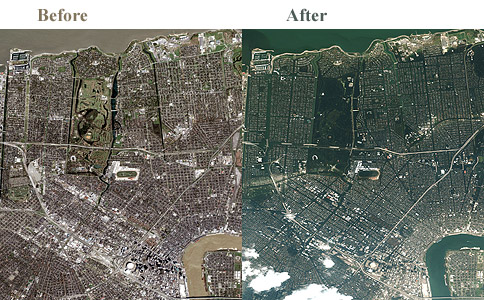
White plumes of water clearly mark the levee breaches. Water is seen flowing back out of the Lower Ninth Ward into the 17th Street Canal, as levels in the city continue to equalize. A mud flow on a now-dry embankment clearly marks one of the overtopped stretches of levee on the west side of the canal .
Other very clear and useful overhead pictures are taken by US government survey photographers in a Cessna airplane.

Wednesday, August 31 - T+2 Days:
Sightings of Condoleezza Rice abound, all over the tonier parts of Manhattan. In the morning, the US Secretary of State, former National Security Officer, and bigtime bush confidante, is spotted playing tennis with Monica Seles.
Later that day, security guards swarm 5th avenue, where a number of witnesses corroborate the description of an incident at a posh Ferragamo store, where Rice buys several thousand dollars worth of shoes. Another customer is seen approaching Rice and shouting, "How dare you shop for shoes while thousands are dying and homeless!" Rice orders security to remove the person from the building.
Similar scenes on 7th Avenue later in the day.
That night, Rice is spotted at a performance of "Spamalot," one of the tougher tickets in NYC. After the lights come up at the end of the show, someone points her out. Several Schubert Theater patrons boo. The event is reported in NYC papers.
Wednesday, August 31, 12:20 PM - T+2 Days, 6 hours, 10 minutes:
Marty Bahamonde sends the following e-mail to his boss from the Superdome area:
From Bahamonde, Marty
To: [Michael D. Brown]
Sent: Wednesday, August 31, 12:20:20 2005
Subject: New Orleans
Sir, I know you know that the situation is past critical. Here some things that you might not know.
Hotels are kicking people out, thousands gathering in the street with no food or water.
Hundreds still being rescued from homes.
The dying patients at the DMAT tent being medivac. Estimates are many will did [sic] within hours. Evacuation in progress. Plans developing for dome evacuation but hotel situation adding to problem. We are out of food and running out of water at the dome, plans in works to address the critical need.
FEMA staff is OK and holding own. DMAT staff working in deplorable conditions. The sooner we can get the medical patients out, the sooner wecan get them out.
Phone connectivity impossible
More later
-----------------------
Sent from my Blackberry Wireless Handheld
Bahamonde receives the following response from Michael Brown:
From: Brown, Michael D
Sent: Wednesday, August 31, 2005 12:24 PM
To: [Marty Bahamonde]
Re: New Orleans
Thanks for update. Anything specific I need to do or tweak?
Wednesday August 31, 5:02 PM - T+2 days, 11 hours, 52 minutes:
General Graham arrives in Baton Rouge, and is whisked into a meeting with Honore, Blanco, and several others. Public transcripts show Honore telling Graham, "Mark, evacuate the City of New Orleans and the Greater New Orleans area." Graham answers with a crisp "Yes, sir." It takes about 36 hours to get a full, major evacuation on the ground and functioning. Given the chaos in force at the time, this is actually rather remarkable. Problem is more that the process took this long to get started.
Wednesday, August 31, evening - T+2 Days, 12 hours:
Ray Nagin states that, while Louisiana does not recognize martial law as a legal recourse, he has declared something similar in New Orleans. Local police will not be expected to Mirandize suspected looters, and other rights of arrestees are suspended.
Wednesday, August 31, evening - T+2 Days, 12 hours:
Bahamonde is cc'd in on the following e-mail from Sharon Worthy, Brown's press secretary, telling everyone to hold on and try not to die while Brown finds a nice place for dinner in Baton Rouge before going on TV:
"He needs much more that 20 or 30 minutes. Restaurants are getting busy. We now have traffic to encounter to get to and from a location of his choise, followed by wait service from the restaurant staff, eating, etc. Thank you."
Bahamonde sends the following e-mail to a co-worker:
"OH MY GOD!!!!!!! I just ate an MRE and crapped in the hallway of the Superdome along with 30,000 other close friends so I understand her concern about busy restaurants."
Thursday, September 1 - T+3 days:
Another bad night, followed by trouble at the Superdome as desperate people who have heard about the bus transportation attempt to rush the facility, which has been locked down, sort of, by National Guard. Acadian Air Ambulance company ceases helicopter evacuation of worst medical cases after gunfire of unknown origin. Emergency generator stolen at a dispatch facility; dispatch down. Triage, such that it is, now at an adjoining sports arena.
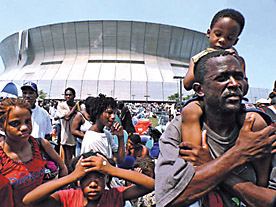
Bus evacuation off to a slow start. Huge line of people, few buses. Double skirmish line of National Guard troops keeps order. The evacuation of the Superdome lasts several days. There is at least one more political incident when the mayor allows 400 relatively clean and well fed hotel guests to the front of the line for bus transportation.
The Astrodome quickly reaches capacity (15,000 people), and another facility next door is opened to handle the overflow.
Communications continue to deteriorate. No landline or cell phones. Generators fail or run out of fuel. Agencies switch to hand hand-held radios, until the batteries run down. No procedures for charging on emergency power. No interoperability. No radio discipline. No plan.
A FEMA cache of hundreds of radios, with chargers, sits idle far from the city. Radio towers, which were double-guyed for hurricanes, do survive for the most part, but they begin to fail for mysterious reasons that engineers consider no accident. No one knows who's doing it, but everyone seems to think equipment is being sabotaged by Federal agents who want all the traffic to be over (nonexistent) Federal radios.
One communication department catches FEMA personnel disconnecting its emergency phone lines. They chase them off, and call for sheriff's deputies to guard the repaired lines. Someone else reports that antennas on their tower have been disconnected, and the lines have been reconnected to FEMA equipment secretly installed on the tower.
Highly trained ham radio operators in a Salvation Army disaster team report that they are being jammed. Weird, but technically possible, stories of powerful countermeasures signals from a Navy ship, along with jamming from Caribbean pirate broadcasters, spill out onto the Art Bell show. Art Bell, who has a ham radio license, tries to sort out the technically feasible radio malfunctions from his show's general weirdness. The FCC claims the ham radio problem is being caused by sunspots. On at least the HF bands, this is partly true, but it does not explain why a powerful Navy transmitter is apparently blocking circuits in poorly shielded VHF ham radios.
Another attempted evacuation of Charity Hospital is stopped after someone hears shots. Accounts persist that a sniper was shooting at them. (Anderson Cooper on CNN)
CNN Correspondent Adaora Udoji reports: "Three days after Hurricane Katrina, and the situation is getting more desperate by the minute. Thousands are still stranded in misery. They are marching in search of food, water and relief. They're surrounded by a crumbling city and dead bodies. Infants have no formula, the children no food, nothing for adults, no medical help. They're burning with frustration, and sure they have been forgotten."

AP runs a photo by Phil Coale, with a helicopter view of school buses sitting useless in a flooded New Orleans lot. This becomes a major controversy. People ask why these weren't used in the city evacuation plan before the hurricane. The mayor answers that bus drivers were busy saving themselves, and the buses could not even be moved to safer ground, let alone used to carry passengers. Regardless of who was at fault, the photo forever becomes known as "Nagin's Navy," or the "Nagin Motor Pool."
Thirty-thousand more National Guard Troops from across the country are ordered to report to the Gulf Coast, ultimately streaming in over a period of several days.
Media reports of damaged refineries and infrastructure cause a massive gasoline panic in Georgia. Long lines form at gas stations in Atlanta, with massive price gouging. Gasoline prices increase in most of the U.S..
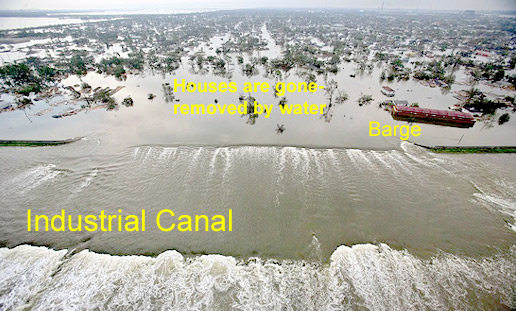
Note water flow back into canal.
Thursday, September 1 - T+3 days:
Dennis Hastert tells an Illinois newspaper that "It looks like a lot of that place could be bulldozed." Blanco goes ballistic in a follow-up statement to the same paper, saying, "To kick us down when we're down and destroy hope" is an insult to a historic city which has given a lot to the world. Hastert later says he was quoted out of context.
Praise the Lord and pass the ammunition: Blanco announces yet another prayer vigil, then when asked about whether National Guard can restore order in the city, gives her infamous statement that, "These are battle-tested Louisiana National Guard back from Iraq. They have M-16s and are locked and loaded. These troops know how to shoot and kill and I expect they will."
Thursday, September 1 - T+3 days:
Hair today, gone tomorrow: Barry Cowsill, the bass player of the popular 60s family band, calls his sister's answering machine to report that he is alive, but facing major trouble of an unknown nature. Cowsill, who had experienced substance abuse issues on and off according to the Boston Herald, had meant to fly to Los Angeles and enter rehab the day Katrina hit. Instead he had been lost in the chaos when the city evacuated. Unfortunately, this one reappearance is the last anyone hears from Cowsill, and he is eventually added to the list of Katrina missing persons.
Thursday, September 1, late afternoon - T+3 days, 10 hours:
US State Department advises that Condoleezza Rice has fled New York and is now looking busy in DC.
FEMA head Michael Brown gives the following interview on CNN:
Brown : And so, this -- this catastrophic disaster continues to grow. I will tell you this, though. Every person in that Convention Center, we just learned about that today….
Zahn: Sir, you aren't telling me...
Brown : ... and that we take care of those bodies that are there. . . .
Zahn: Sir, you aren't just telling me you just learned that the folks at the Convention Center didn't have food and water until today, are you? You had no idea they were completely cut off?
Brown: Paula, the federal government did not even know about the Convention Center people until today.
Later, Brown will say he was wrong and that FEMA actually knew about the victims at the Convention Center 24 hours earlier (still too late) but was unable to reach them until Thursday. Others will say he is lying.
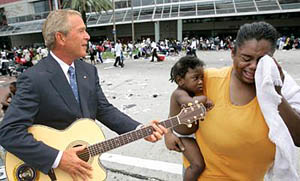
Thursday, September 1 - T+3 days, 12 hours:
Evening - Mayor Nagin loses it in an interview on WWL, and tells it like it is:
"I need reinforcements, I need troops, man. I need 500 buses, man. . . I've got 15,000 to 20,000 people over at the convention center. It's bursting at the seams. The poor people in Plaquemines Parish. ... We don't have anything, and we're sharing with our brothers in Plaquemines Parish. It's awful down here, man. Don't tell me 40,000 people are coming here. They're not here. It's too doggone late. Now get off your asses and do something , and let's fix the biggest goddamn crisis in the history of this country."
Thursday, September 1, 6:54 PM - T+3 days, 12 hours, 44 minutes:
FEMA's Robert Fenton, who is working in Mississippi, sends the following e-mail to "FEMA-LRC-Deputy-Chief" and a very long list of other people (not including Brown or Chertoff):
I hope this report [of available supplies] is in error, we ordered 450 water and 450 ice per day, two day's ago which was suppose to start tomorrow. Prior to that on August 28th we ordered 255 water and 255 ice per day to start on August 30th. We have not yet met any of our requirements even with two day's notice. If we get the quantities in your report tomorrow we will have serious riots.
Thursday, September 1, 10:56 PM - T+3 days, 16 hours, 46 minutes:
Fenton sends the following e-mail to "Carwile, William:"
The report say's 60 ice 26 water tomorrow, this will cause significant issues or requirements is 450 water 450 ice.
Thursday, September 1, 11:17 PM - T+3 days, 17 hours, 7 minutes:
Carwile sends the following e-mail to Fenton and six others:
Turns out this report is true. Bob just got off a call with Rudy and there seems to be no way we will get commodities in amounts beyond those indicated below. And it turns out these shortfalls were known much earlier in the day and we were not informed.
Will need big time law enforcement reinforcements tomorrow. All our good will in MS will be seriously impacted by noon tomorrow. Have been holding it together as it is.
Can no longer afford to rely on LRC. Fully intend to take independent measures to address huge shortfalls.
Do you guys want to tell MDB [Brown?] and Patrick or should I?
Friday September 2 - T+4 days:
In the late night hours, a large explosion shakes much of New Orleans. It turns out to be at a chemical storage facility in the 3400 block of Chartres Street, on the Mississippi River east of the Industrial Canal, and ironically near Desire Street. For the rest of the night, the sky lights up from secondary explosions in a string of tank cars. When day breaks, the sky is obscured by a thick cloud of acrid smoke, added to by nearby (unrelated) structure fires, including one in a snack shop near Harrah's Casino. The chemical fire burns for two days.
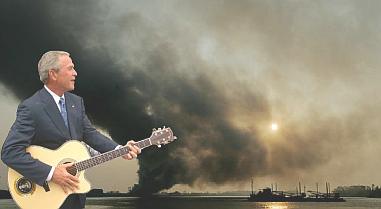
Yet another bad night. Media report shots fired in the French Quarter, and blood streams from the body of a shooting victim in another part of the city.
Friday September 2 - T+4 days:
The Red Cross again requests entrance to New Orleans with relief supplies. They are told that 24 hours will be needed to prepare for their arrival. 24 hours later, the priority has shifted to emptying out the city. The aid never gets there at all.
Friday September 2, 8:00 AM - T+4 days, 1 hour, 50 minutes:
President gives a statement upon leaving the White House for the affected zone. Now he has changed his tune to, "The results are not acceptable."
Friday September 2, 8:37 AM - T+4 days, 2 hours, 27 minutes:
Brown sends the following e-mail to Betty Guhman:
From: Brown, Michael D
Friday September 2, 2005 8:37 AM
To guhman[rest redacted]
Subject: Re: still a star!
Last hurrah was supposed to have been Labor Day. I'm trapped now, please rescue me.
Friday September 2, 10:30 AM - T+4 days, 4 hours, 20 minutes:
At a press conference at Mobile Regional Airport, AL, the president changes his tune yet again. He says, "Brownie, you're doing a heck of a job." Brownie, whose job previous to running FEMA was administering the judging for horse shows, is not doing a heck of a job, and he will be "rescued" (relieved of responsibility) shortly after.
Friday September 2, 12:00 Noon - T+4 days, 5 hours, 50 minutes:
National guard "cavalry comes over the hill," with supplies and a large troop contingent. A convoy of Army trucks reaches the Convention Center with massive loads of water and MREs. First public appearance of JTF-Katrina's Regular Army Lt. Gen. Russell Honore, a no-nonsense, hands-on general who tends to say "Over" at the end of his measured replies to press questions. Honore, a Louisiana African-American, is perfect for the job. He takes charge and moves out like the perfect John Wayne character, and is probably the second Good Guy to be seen in any of this. (The Coast Guard admiral, Good Guy #1, was the first.)
Along with Honore and his "Over," CNN carries the first public appearance of Good Guy #3, the Army Engineers' Brigadier General Mark Graham, who is serving as deputy commanding general of JTF-Katrina's Task Force West. Graham has been explicitly tasked by Honore with completely evacuating New Orleans, and (aided by a staff of 24 officers) he proceeds to cut through mountains of red tape and accomplish just that. 72 hours later, around 100 buses have emptied the Superdome and Convention Center, and a total of 65,000 people is finally out of New Orleans. These people go to their uncertain fate in the evacuee system.
A photo of Good Guy #3 would be here, except he is so unsung a hero that none can be found online.
Large contingents of National Guard troops arrive with weapons in an offensive posture, pointed at buildings and crowds, just as promised by the governor. Honore rapidly orders a defensive weapons drill, with rifles pointed down and fingers off triggers.
3000 people who have made it to the University of New Orleans, a campus right on Lake Pontchartrain which has become basically an island, are helicoptered out by the many choppers that are starting to fill the skies.
Engineers at a press conference estimate that they will need 80 days to drain New Orleans.
Friday September 2, 5:00 PM - T+4 days, 10 hours, 50 minutes:
President reaches New Orleans airport, which has been taken over as a landing zone and a massive, extremely crowded, triage site for evacuating residents, with Blackhawks and other choppers bringing in thousands of sick, injured, or just dazed people. With cameras and recorders rolling, he dispenses the following gems:
"The good news is...that out of this chaos is going to come a fantastic Gulf Coast.... Out of the rubbles of Trent Lott's house--he's lost his entire house--there's going to be a fantastic house. And I'm looking forward to sitting on the porch."
"I believe the town where I used to come - from Houston, Texas, to enjoy myself, occasionally too much - will be that very same town, that it will be a better place to come to."
Friday, September 2, evening - T+4 days, 12-15 hours:
NBC broadcasts "A Concert for Hurricane Relief," one of those live celebrity telethon things that always seem to follow every disaster, to raise money for the Katrina recovery. Kanye West stops the show when he ad-libs:
"I hate the way they portray us in the media. If it's a black family, it says we're looting. If it's a white family, it says they're looking for food. And you know that it's been five days because most of the people are black. And even for me to complain, I would be a hypocrite because I would turn away from the TV because it's too hard to watch. We already realize that a lot of people that could help are at war right now, fighting another way, and they have given them permission to go down and shoot us. George Bush didn't care about black people."
Mike Myers, West's co-host, reacts with a priceless look of stunned disbelief. Finally, the camera cuts abruptly to the next host, who is looking the wrong way and completely unready.
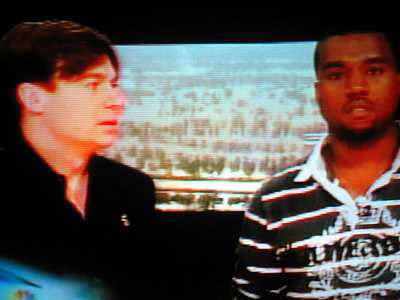
The telecast airs delayed on the West Coast. NBC broadcasts it with West's remarks censored out. The network's excuse is, "Kanye West departed from the scripted comments that were prepared for him and his opinions in no way represent the views of the networks." This, of course, causes a PR disaster for NBC.
Friday September 2, 10:00 PM - T+4 days, 15 hours, 50 minutes:
The president finishes his tour, and announces that 7000 more troops are on the way. The Army Corps of Engineers begins its plan to intentionally breach levees in a number of places south of New Orleans to allow the Chalmette and Plaquemines areas to drain back into the MRGO and a freshwater canal. The breaches on the Industrial Canal are temporarily left as is, to allow the similar gravity drainage out of the Lower Ninth Ward to continue.
There is a brief incident at the Industrial Canal locks, when the Corps of Engineers raises a bridge to allow navigation, thus cutting an escape route from the Lower Ninth Ward. After residents storm the bridge, the lockmaster lowers it for the duration, closes up the facility, and leaves.
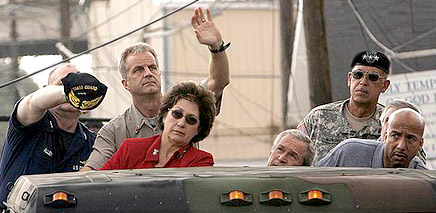
(L to R:) Good Guy #1 (using hat to touch wire), unidentified,
Loser #1, Loser #3 (scared spitless), Good Guy #2, unidentified, Loser #2
Saturday, September 3 - Evening - T+5 days, 12 hours:
US Chief Justice William H. Rehnquist dies, opening a second vacancy on the Supreme Court.
Sunday, September 4 - T+6 days:
The President issues a proclamation ordering the US Flag to be flown at half-staff at all federal buildings until Sept. 20 "as a mark of respect for the victims of Hurricane Katrina." Needless to say, everyone thinks the flags are half-masted for Rehnquist.
Sunday, September 4 - T+6 days:
Time for the Sunday morning TV punditocracy to flog Katrina.
Aaron Broussard, president of Jefferson Parish, on Face the Nation:
"We have been abandoned by our own country. Hurricane Katrina will go down in history as one of the worst storms ever to hit an American coast, but the aftermath of Hurricane Katrina will go down as one of the worst abandonments of Americans on American soil ever in U.S. history."
"Nobody's coming to get us. Nobody's coming to get us. The secretary has promised. Everybody's promised. They've had press conferences. I'm sick of the press conferences. For God sakes, shut up and send us somebody."
"And whoever is at the top of this totem pole, that totem pole needs to be chain-sawed off and we've got to start with some new leadership. Take whatever idiot they have at the top of whatever agency and give me a better idiot. Give me a caring idiot. Give me a sensitive idiot. Just don't give me the same idiot."
Bob Schieffer then wraps the show with:
"As the flood waters rose, local officials in New Orleans ordered their city evacuated. They might as well have told their citizens to fly to the moon. How do you evacuate when you don't have a car? No intelligent design in any of this. This was just survival of the richest."
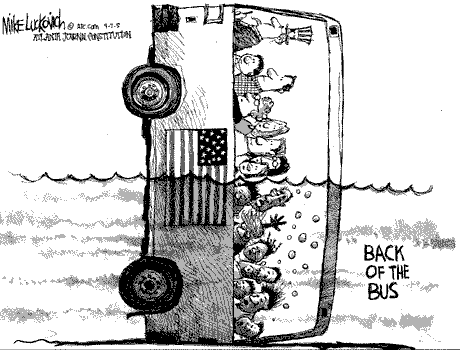
Sunday, September 4, ~9:00 AM - T+~6 days, 2 hours, 50 minutes:
Police check out reports of snipers on the Danziger Bridge, which crosses the Industrial Canal near the levee breaches. Thus begins a real, old-fashioned, OK-corral shootout. The result is a confusing, Rashomon-like incident where everyone involved tells a different story.
Points of agreement in the news media (but see later): Two armed groups shot it out on the bridge. Multiple fatalities and injuries. Some unknown connection to personnel attempting to plug the levee breach. Police by that point were often out of uniform and carrying anything that would shoot, so they did not necessarily look like cops. However, these particular police were definitely on duty and doing serious work to restore order in the city.
Version #1
(initially reported on CNN and other cable news): US Army Corps of Engineers engaged New Orleans police on the bridge, killing 9.Version #2
(apparently random fact drift in the confusion): US Army contractors on the way to the levee are engaged by a gang of looters. Police show up. 9 looters killed.Version #3
(appears within minutes on the Internet conspiracy sites): US Army on the way to further damage the levee and flood out more African Americans is engaged by indignant local citizens. Army and/or police kill 9 of them.Version #4
(deputy police chief at press briefing): 14 civilian contractors in a convoy being escorted to the levee breach draw sniper fire from the bridge. Police and/or Army and/or both engage the snipers. 4 killed in subsequent shootout.Version #5
(police source to Reuters): Armed gang of 5 looters fires on police escorting contractors across the bridge. Police engage looters, killing 4 and wounding 1.Version #6
(another police source): Police return fire from gang of 8. 5-6 killed.Version #7
(subsequent police source): Police return fire from gang of 7. 2 killed, 2 wounded, 2 arrested, one at large.Version #8
(from investigations weeks later): Two families which had fled to dry ground find selves in the wrong place at the wrong time. A group of 7, comprised of three Bartholomews, nephew Jose Holmes, an unrelated friend of Holmes, and two Madison brothers, cross the bridge. The Madisons are apparently running from some kind of altercation with an armed gang, while trying to reach a relative's dental office on the other side. The Bartholomews claim they are trying to escape the wretched conditions and crime in the Lower Ninth Ward, and get out of the city.The group, some but not all of whom are armed, is engaged by police, who are checking out the sniper report. Both sides say the other fired first. All three Bartholomews are wounded by police gunfire. One loses an arm, essentially has it blown off, after being shot point blank with a shotgun. Ronald Madison (a mentally impaired person) flees in an attempt to reach the dentist's office, and is cornered in a motel parking lot, where he is killed by police after making a suspicious move toward his belt. Jose Holmes is shot at point blank range by a police officer with an assault rifle. His insides are completely torn up, but he survives with a colostomy bag for the rest of his life. Two dead, four wounded. No police hurt. Holmes and Madison face attempted murder charges.
Version #9
(later police statement): Police were NOT escorting contractors to the levee site. Seven officers responded on an "officer down" call from other police who had gone to check out a report of snipers firing at work boats from the bridge.Version #10
(Bartholomews' statement): They were escaping a squalid motel and trying to get out of the Lower Ninth Ward. The cops just snapped and opened up on them.Version #11
(police statement on above): Holmes was a sniper. He continued fire from behind a concrete barrier and was taken out.Version #12
(Madison's statement): Police mistook the Madisons for snipers, and shot at them.Version #13
(Police statement on above): Lance Madison fired on police and threw his gun in the canal. Ronald Madison fled to the motel and was killed in a justifiable shooting after making threatening moves toward an officer in pursuit.
In November, a prosecutor opens an investigation in an attempt to finally sort it all out. On Thanksgiving Day, the Los Angeles Times runs a long story on the whole confusing mess, complete with maps, circles, arrows, and paragraphs of information. The matter is far from concluded.
[UPDATE: A grand jury investigation resulted in indictment of all seven cops, four for first-degree murder, three for second-degree. Madison's dentist brother is now active in seeking justice in the case. He has been telling media that the civilians were by that point unarmed, and that the cops, though arriving in a rented car and not wearing uniforms, did not identify before they started shooting. He also says both dead were shot in the back, one execution-style up against a truck.]
[UPDATE #2: On August 13, 2008, Criminal District Court Judge Raymond Bigelow threw out all charges against all seven cops on technicalities relating to prosecutor misconduct. An assistant DA, who no longer works there, illegally showed grand jury testimony to a witness. The judge also called three of the indictments improper, and ruled that the grand jury had been instructed improperly. The prosecution has not decided if it will appeal the decision. So it goes.]
[UPDATE #3: On February 24, 2009, in another federal case brought after the collapse of the 2008 trial, former police Lt. Michael Lohman pleaded guilty in federal court to one count of conspiring to obstruct justice. In this plea, he admitted that he arranged a cover-up (Version #13 above) with the involved officers that included planting a weapon and lying about the whole incident. Nearly 5 years later, Version #10 starts to sound like the right one.]
[UPDATE #4: Federal cases wrap up with convictions of all defendents. Four of these could get life in prison. One more is already doing time, while a 6th was only involved in the cover up, for which he was found guilty. Six years later, it is now clear that a gang of cops responding to a nonexistent sniper over-reacted with a group of civilians now proven to be completely unarmed.]
Sunday, September 4, evening - T+6 days, 4 hours, 7 minutes:
Press secretary Sharon Worthy sends Michael Brown the following fashion tip:
Subject: your shirt
Please roll up the sleeves of your shirt... all shirts. Even the President rolled his sleeves to just below the elbow.
In this crises and on TV you just need to look more hard-working...ROLL UP THE SLEEVES!

Sunday, September 4, evening - T+6 days, 12 hours:
In a TV interview, Nagin criticizes bureaucracy and delays in beginning repair work on the breached 17th Street Canal. He says that helicopters were pulled off the dropping of bags into the breach to be used on rescue missions. "There are too many fricken cooks," says Nagin.
Monday, September 5 - T+7 days:
82nd Airborne, the Regular Army unit recently pulled out of Iraq after an abuse scandal, deploys to New Orleans.
Homeland Security finalizes an operations plan with Customs & Border Protection air and Border Patrol assets. A fast A-STAR reconnaissance helicopter is deployed to the downtown landing zone, and Blackhawk choppers bring in 87 Border Patrol agents to work with New Orleans city police. In addition, ICE (Immigration and Customs Enforcement) agents join New Orleans SWAT operations and water rescues.
U.S. Army Corps of Engineers finally seals the levee breach on the 17th Street Canal, and the first large pump gushes water from the city back into the canal.
Tuesday, September 6 - T+8 days:
FEMA asks reporters to refrain from taking pictures of the dead. Reuters quotes a FEMA email as follows: "The recovery of victims is being treated with dignity and the utmost respect and we have requested that no photographs of the deceased be made by the media." Reuters further reports that unnamed "media groups" are accusing FEMA of censorship, in the same way that returning US war dead cannot be photographed.
Nagin orders police and law enforcement officials to remove everyone from the city who is not involved in recovery efforts. He says that people still there by the end of the week will be removed by force. Several neighborhoods that escaped the flooding refuse to comply. The city ultimately backs off from the spectacle of Americans being driven from their homes at gunpoint.
Wednesday, September 7 - T+9 days:
After being attacked by Blanco for leaving dead bodies rotting in the flood and heat for over a week, FEMA brings in Kenyon International Services, a Houston company of course, to assist in recovering the corpses. Media report that the firm has a bad record. A week later, state and federal officials will still be bickering over who is to pay the $119,000 daily expense, and many bodies will still lie uncollected two weeks after the storm. A month later, only 32 of the badly decomposed bodies will have been positively identified. A few weeks after that, FEMA stops processing bodies at all.
Thursday, September 8, 3:02 AM - T+9 days, 20 hours, 52 minutes:
Carol Springman, a person of unknown affiliation (redacted on the released document), sends a very long e-mail to president@whitehouse.gov, vice-president@whitehouse.gov, Brown, Michael D, and comments@whitehouse.gov. It is regarding the by then continuous news accounts of people refusing to evacuate because they are required to leave pets behind. She begins:
Subject: SAVE THE ANIMALS OF NEW ORLEANS TO SAVE THE PEOPLE!
I saw this HSUS [presumably the Humane Society] press release and this Baton Rouge newspaper article (see below) on the Internet tonight.
Be assured that the vast majority of the citizens of this nation believe it is absolutely criminal, utterly cruel and beyond comprehension that the federal, state and local are withholding public resources that could be used to rescue the non-human family members (which are also legally considered to be their personal property) of Katrina's victims. This is doubly so when it's known that some of the victims who are refusing to leave are doing so because the "rescuers"
will not allow them to take their animals with them.
Like I said this is just incomprehensible, cruel and criminal. […]
Who says private citizens have no input into government policy? At 10:38 AM, only 7 hours and 36 minutes later, which has to be a shortest response time for the entire Katrina situation, Brown orders the following:
I want us to start planning for dealing with pets. If evacuees are refusing to leave because they can't take their pets with them, I understand that. So we need to facilitate the evacuation of those people by figuring out a way to allow them to take their pets. Bill and Ron, this may not be an issue for you in AL and MS, but it is a huge issue in LA. Please get some sort of a plan together to start handling the pets. Thanks. MB
We may never know just who called Brown and raised hell, or if this is further evidence that Brown is far more comfortable dealing with animals than people. In any event, the evacuation begins allowing animals. This is a good thing, because many people really had been refusing rescue unless the pets could come too.
Thursday, September 8 - T+10 days:
President Bush issues an executive order suspending the 1931 Davis-Bacon Act for Katrina reconstruction. This law requires federal contractors to pay the prevailing wage. There is an immediate controversy over whether the government is allowing corporations to profit from disaster. Names like "Halliburton" and "KBR" start to be bandied about.
Thursday, September 8 - T+10 days:
FEMA begins a new program which offers debit cards rather than cash direct deposits to evacuees. The cards are useful, especially in cases where poor people have no bank accounts, or there are storm-related problems accessing them. At least 10,000 are quickly given out, mostly at the Astrodome and two other Texas sites. Users of the cards agreed to spend the money on disaster-related expenses to re-establish their lives, but the usual welfare-cheater stories begin almost immediately. For this and other reasons, the program only lasts three days.
Friday, September 9 - T+11 days:
Brown goes slinking back to Washington with his tail well behind his legs, after Chertoff removes him from his heck of a job, and puts Coast Guard Vice Admiral Thad W. Allen (good guy #1) in charge.
Sunday, September 11 - T+13 days:
FEMA stops issuing the debit cards. People who have waited days for these cards find them suddenly unavailable. The Red Cross continues to offer $2000 debit cards of its own. Someone far from the hurricane tries to buy a Ferrari with one of these, after news photos accidentally reveal a number and expiration.
A pro-war 9/11 anniversary DC media event planned for months by the Bush administration goes largely ignored due to the Katrina story.
Monday, September 12 - T+14 days:
Brown resigns as head of FEMA, saying, "It is important that I leave now to avoid further distraction from the ongoing mission of FEMA." He is replaced by U.S. Fire Administrator David Paulison, the same guy who told people in 2003 to stock up on duct tape and plastic sheeting in case of a terrorist attack.
Monday, September 12, 8:00 AM - T+14 days, 1 hour, 50 minutes:
Amy Goodman broadcasts Democracy Now! live from Algiers. She accompanies local activist Malik Rahim as he tries, on-air, to get someone to pick up a dead body. From the transcript at democracynow.org:
MALIK RAHIM: Now, his body been here for almost two weeks. Two weeks tomorrow. All right. That this man's body been laying here. And there's no reason for it. Look where we at? I mean, it's not flooded. There's no reason for them to be -- left that body right here like this. I mean, that’s just totally disrespect. You know? I mean two weeks. Every day, we ask them about coming and pick it up. And they refuse to come and pick it up. And you could see, it's literally decomposing right here. Right out in the sun. Every day we sit up and we ask them about it. Because, I mean, this is close as you could get to tropical climate in America. And they won't do anything with it.
As if on cue, various agencies see Goodman and Rahim making their radio show, and appear on scene. In order of appearance, she asks the following people what to do to get the body picked up:
-Soldier, Bravo Company, 1/5 Cavalry, Regular Army, Ft. Hood, TX (recently back from Iraq); who says they'll have to call the "local authorities."
-Louisiana state trooper, who says they'll have to talk to his public information officer.
-State trooper's partner, who says the same thing, and drives off.
-Robert Gonzalez, also with the 1/5 Cav, who says people have examined the body, but he doesn't know why it's still there.
-New Orleans police officer, who says that he'll have to notify his chain of command.
-New Orleans police lieutenant, who is in the chain of command, says the body is out of his jurisdiction, but that he has reported it.
-Jeremy Fowler, who appears and identifies himself as Company Commander, US Army 1/5 Cav, who says the police have been too busy to get a mortuary team to that side of the river.
-Matthew Cohen, Fowler's superior, a Captain in the 1/5 Cav, who only says he's happy to be back in the USA helping Americans.
-Another New Orleans cop, who refuses to comment, saying call the press liaison.
After this, Rahim recounts stories of racist behavior by New Orleans cops, their failure to stop vigilantism by whites, and the tendency to describe blacks stealing things as looting, but whites stealing things as foraging.
No one ever does figure out what to do with the body, which continues to rot in the sun.
Tuesday, September 13 - T+ 15 days:
The Louisiana Attorney General charges Salvador and Mable Mangano with 34 counts of negligent homicide in the deaths of 35 elderly patients at their nursing home. (The 35th body was found later.) The charges allege that the patients could have been evacuated in time, but the owners disregarded the St. Bernard Parish evacuation orders, and tried to ride out the storm until flooding reached the top of the building.
Tuesday, September 13, 11:30 AM - T+ 15 days, 5 hours, 20 minutes:
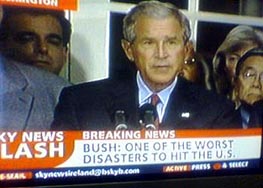
In an aside from a White House photo op with the new president of Iraq, bush changes his tune once again. He says, "Katrina exposed serious problems in our response capability at all levels of government. And to the extent that the federal government didn't fully do its job right, I take responsibility. I want to know what went right and what went wrong."
Thursday, September 15 - T+17 days:
Cover date of Albuquerque's Weekly Alibi, a New Mexico alternative weekly which prints a letter from local Veteran's Administration nurse Laura Berg. She identifies herself as a "VA nurse," then proceeds to strongly criticize the Bush administration for its performance in Katrina and its priorities in diverting assets to Iraq. She calls upon the public to remove "Bush, Cheney, Chertoff, Brown, and Rice" from office, and suggests that they "be tried for criminal negligence."
Upon learning about this letter, Berg's bosses sieze her work computer. When she demands an explanation, the HR department admits that the letter was not found on her computer, but also that, "The Agency is bound by law to investigate and pursue any act which potentially represents sedition."
The ACLU and Senator Jeff Bingaman (D-NM) investigate the case. Says an ACLU spokesman: "Sedition? That’s like something out of the history books."(The Progressive)
Thursday, September 15 - T+17 days:
The Blame Game, as the Presidential media echo chamber is now derisively dismissing a massive public outcry, continues: Brown blames Blanco, Blanco blames Brown, Nagin blames everybody, everybody blames the feds. Brown tells a New York Times writer that the governor refused to make decisions or respond to his requests. The governor's office says he is lying.
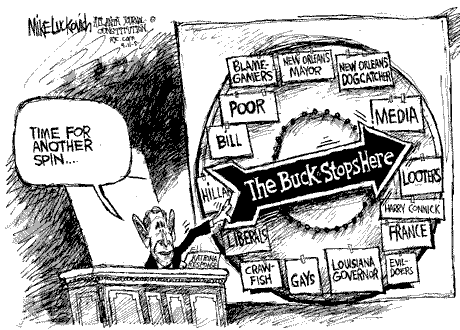
Thursday, September 15, 8:00 PM - T+17 days, 13 hours, 50 minutes:
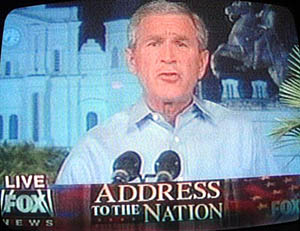
Major televised presidential speech and photo op in Jackson Square. Power in the dark city miraculously works long enough for the presidential motorcade to make it in. The speech itself is staged and lit by top TV talent. Warm incandescent lights bathe the president and make him look comforting, while the nearby cathedral and surrounding historic buildings are dramatically lit by banks of giant HMI arcs running off AC generators that would keep a hospital going just fine. What few people remain in the area are kept blocks away from the president and his giant shoot. After the speech ends, the lights are killed and wrapped. After the motorcade is gone, the city power goes off as mysteriously as it had come on, and New Orleans is dark once again.
In the speech, bush is long on promises and short on action. He promises to spend whatever it takes, stay however long it takes, and do whatever has to be done to get viable communities started again. Then he hints that disasters really should be handled with martial law or something close to it. Soon after, FEMA's authority is reduced even further, completing its amazingly quick transition from a giant cabinet-level emergency management and proaction agency to a largely irrelevant backwater for political cronies. Employees bail out in droves.
Three months later, Congress will still be dithering away, FEMA will still be hopelessly behind and disorganized, money will be tied up, many tasks will be suspended in the middle, and vast expanses of Louisiana and Mississippi will still resemble bomb zones with no concrete plans to rebuild them. The president will be giving a speech about stopping terrorism in Iraq, with no mention of Katrina at all.
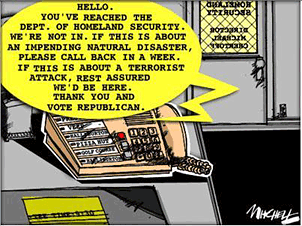
Wednesday, September 18 - T+20 days:
The USDA recalls 400,000 NATO emergency rations paid for by British taxpayers that were sent to the US as Katrina relief. Although these MREs are routinely eaten by soldiers in European military operations, they run afoul of US regulations regarding British beef and Mad Cow Disease. Similarly, a huge shipment of Israeli pear juice is siezed as unfit for consumption. The fate of the NATO MREs is unknown, but most likely they go to an FDA incinerator in Little Rock. (UK Daily Mirror)
Thursday, September 19 - T+21 days:
John Kerry, the presidential candidate that blew the '04 election by conceding before Ohio was counted, grows a spine at Brown University, rebutting Bush's speech as follows:
"The plan they're designing for the Gulf Coast turns the region into a vast laboratory for right wing ideological experiments. They're already talking about private school vouchers, abandonment of environmental regulations, abolition of wage standards, subsidies for big industries, and believe it or not yet another big round of tax cuts for the wealthiest among us!"
Friday, September 23, 8:00 AM - T+25 days, 1 hour, 50 minutes:
Closest approach of hurricane Rita brings rain squalls and a persistent east wind with gusts near tropical storm force. Pictures from TV new cameras looking north from the Claibourne Bridge show water pouring into the Ninth Ward again from three places on the Army's patch job. One looks like a waterfall. Water waist deep in places. National Guard witness quoted on CNN as saying this is the worst case they hoped wouldn't happen. Also some slight flooding from seepage on the London Avenue patch. A remaining deep flood in St. Bernard grows deeper.
Sunday, September 25 - T+27 days:
Army Corps of Engineers successfully sandbags the holes in the Industrial Canal levee. Water stops rising in the Ninth Ward. Rita leaves some coastal towns at the other (west) end of the LA coast 90% - 100% destroyed. (CNN)
Tuesday, September 27 - T+29 days:
Michael Brown puts all the blame on poor Queen Bee again, calling local officials "dysfunctional" in his testimony to a largely Republican Congressional committee. All but two Democrats boycott the hearing, claiming that its rules guarantee a partisan whitewash. 80% on opinion polls want an independent, or at least nonpartisan, investigation. Brown lies under oath by saying the governor did not request an emergency in Orleans Parish. The governor's published document does include the parish, because it expressly specifies the entire state. Reports circulate on news media that Brown has been rehired for one month as a consultant, for a fee of $140,000, to investigate himself.
Media also report that Laura Bush will be on "Extreme Makeover," doing something or other in Biloxi. Apparently the White House contacted the show's producers. The First Family is now so desperate that it has taken to reality TV to improve its image.
Meanwhile, Police Superintendent Eddie Compass, whose department has not done well in the hurricane, turns in his resignation.
Water falls rapidly in the Ninth Ward as pumps once again do the job, though you would never know it from the lack of news coverage. A couple of weeks later, the area is dry again.
Friday, September 30 - T+32 days
U.S. Customs and Border Protection stands down its unified forward command center in Hammond, LA. 650 people performed 1428 missions for this command, including 328 rescues. 25 aircraft, 15 vessels, and 200 vehicles were used.
Friday, October 7 - T+39 days:
US Army Corps of Engineers presents preliminary investigation results in a press conference at the site of the 17th Street breach. Engineers report that the 17th Street and London Avenue levees were NOT overtopped by water before breaking. High water mark on the 17th Street wall was 28 inches below the top. The engineers suggested that the soil below the floodwalls probably failed. They also insist that the barge that came through the Industrial Canal breach did not cause the levee to collapse.
Saturday, October 8, 8:00 PM - T+40 days, 13 hours, 50 minutes:
The re-opened Bourbon Street receives its own crippling blow when Lance Schilling and Robert Evangelist, two white New Orleans police officers, make a bloody mess out of the face of a 64-year-old, African-American, retired teacher who they were trying to cuff for apparent public intoxication.
News media repeat, over and over, a video tape made by journalists in the area. This footage is even more disturbing than the infamous Rodney King video. When a third white officer, Stuart Smith, sees the camera, he slams an Associated Press producer against a car, and delivers a threatening, profanity-laced tirade including, "I've been here for six weeks trying to keep [expletives deleted] alive. [Expletives deleted.] Go home!"
At various points in the spectacle, the camera is repeatedly (and intentionally) blocked by (quite literally) a horse's ass, when a mounted officer attempts to block the view of street "justice" in progress.
The three New Orleans officers are charged with battery and suspended without pay. Nothing happens to Feds who showed up on scene and participated in the beating. Davis is taken to an Army hospital facility, where tests are negative for drugs and alcohol. He is booked on a number of offenses, and released on bail.
The massive publicity further exacerbates nationwide racial animosity stemming from the Katrina disaster, and does nothing for the reputation of a badly stressed police department which was known for corruption and brutality even before the hurricane. Two months later, in December, the two officers actually involved in the beating are fired following an investigation.
Saturday, October 8, 8:00 PM - T+40 days, 13 hours, 50 minutes:
Amtrak resumes regular service on the City of New Orleans train from Chicago. The train had stopped running due to damaged railroad tracks and bridges, plus the use of the New Orleans station as a temporary jail.
In December, Arlo Guthrie and friends ride the train for a "City of New Orleans Tour," which stops along the way to play fund-raising benefits to help New Orleans musicians replace their equipment, before wrapping up with two nights in the Easy. Despite having a huge hit with the Steve Goodman song which made this train famous, Arlo had never actually been on the route until this tour.
Sunday, October 9 - T+41 days:
Deadline for all Katrina victims to be out of shelters comes and goes, with 11,000 still in shelters and 4,000 of these still in sports stadiums.
Sunday, October 23 - T+55 days:
Ground water causes a third flood on Florida and Jourdan Avenues in the Lower Ninth Ward after temporary pumps are turned off for the day. Water is a foot deep in places. USACE spokesmen note that permanent city pump is still inoperative for at least two more weeks. This section of the Lower Ninth Ward remains completely closed and patrolled by National Guard troops. Water, power, and gas remain out, and a toxic chemical residue coats everything.
Tuesday, October 25 - T+57 days:
NPR Morning Edition reports that lawyers have already filed suits seeking recovery of damage in the levee collapse, and that class action status is being sought.
Tuesday, October 25 - T+57 days:
Three days after hurricane Wilma blasted south Florida as a category 3, there are major problems with relief supplies. Gasoline is scarce and stations without power cannot pump. People wait 5 hours for ice and food. Loaded trucks sit around awaiting instructions on where to go. In large cities, FEMA is invisible again.
Governor Jeb Bush, the president's brother, makes a remarkable statement blaming the victims for their problems, because they might not have stockpiled 3 days' worth of food, water, and supplies when they were warned of the coming storm. Many note that thousands of senior citizens in Florida lack the financial means or mobility to lay in such a large cache, and anyway it had already been three days.
Wilma, for the first time ever, uses up the last available storm name in the yearly list of 23. The weather service starts over in the Greek alphabet. 2005 has set the records for the most named storms, the most major hurricanes, and the most category 5 hurricanes, and there is a month to go.
Wednesday, October 26 - T+58 days:
Nagin has the first weekly Town Hall meeting in New Orleans instead of Baton Rouge.
Wednesday, October 26 - T+58 days:
After intense criticism from moderate Republicans and organized labor, the Bush administration quietly cancels the executive order suspending the Davis-Bacon prevailing wage law in the Katrina zones. The requirement that federal contractors pay the going wage is reinstated.
Thursday, October 27 - T+59 days:
The Department of Homeland Security extends Michael Brown's lucrative consulting gig for another month.
Friday, October 28 - T+60 days:
The New Orleans Police Department fires 45 sworn officers and 6 civilian employees for abandonment of duty. All had vanished around the time of the hurricane, and none have been heard from since.
The department notes that another 45 officers had previously resigned for various personal reasons, and 15 more resigned when investigated for abandonment.
Early November, 2005 - T+2 months:
Dr. Arjun Sengupta, the United Nations Human Rights Commission Special Reporter on Extreme Poverty, tours New Orleans disaster areas and interviews evacuees living out of town or in shelters. He describes the situation as "shocking," with "gross violations of human rights."
He adds, "The US is the richest nation in the history of the world. Why cannot it restore electricity and water and help people rebuild their homes and neighborhoods? If the US can rebuild Afghanistan and Iraq [No comment], why not New Orleans?"
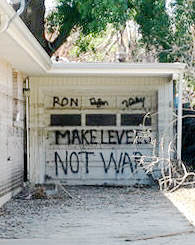
Thursday, November 1 - T+64 days:
New Orleans PD fires 5 more officers for abandonment of duty.
Thursday, November 1 - T+64 days:
Two ranking members of Congressional committees call upon the Army Corps of Engineers to investigate government overpayment in FEMA's "Operation Blue Roof." This follows news reports that the government is paying $3000 to install blue tarps that ordinarily run about $300.
Operation Blue Roof allows owners of damaged homes to apply for temporary repairs with blue tarps, and several hundred thousand homes have done just that, making a rather spectacular sight from the air, but also meaning that any possible overpayments are no chump change.
After hurricane Ivan in Florida, two Federal inspectors on that Blue Roof program were indicted for allegedly taking bribes.
Wednesday, November 2 - T+65 days:
Following an outcry from some members of Congress, Brown quietly resigns his consulting gig. He is dropped from the FEMA payroll.
Thursday, November 3 - T+66 days:
The Washington Post reports yet another possible new player in The Blame Game: corrupt contractors.
"Experts probing the cause of the flooding have received at least a dozen allegations of major cheating by builders and possibly others involved in levee construction, two investigators said in testimony before a Senate panel. They said these were potentially criminal acts that may well have contributed to the collapse of the city's flood-control system on Aug. 29."
Monday, November 7 - T+70 days:
Alarming news reports of ongoing housing problems for Katrina victims. Reports of mass evictions in the poorest areas. Racial inequality everywhere, with rich white neighborhoods rebuilding, and poor African American ones often still devastated and without power. Housing aid running out in other states.
LeftTurn.org reports:
White New Orleans is steadily coming back, and Black New Orleans is moving out. A grassroots organizer with New Orleans Network tells me she has been speaking to people in every moving truck she sees. She reports that in every case, "they're Black, they are renters, they're moving out of New Orleans, and they say they would stay, if they had a choice."
Inequality continues through the cleanup of New Orleans. Some areas have electricity, gas, and clean streets, and some areas are untouched. Medical volunteer Catherine Jones reports that driving the streets of New Orleans at night, " I felt like I was in the middle of a checkerboard. The Quarter lit up like Disneyworld; poor black neighborhoods a few blocks over so dark I couldn't even see the street in front of me."
USA Today reports:
WASHINGTON — Two months after Hurricane Katrina displaced more than 1 million people, problems with federal housing aid threaten to spawn a new wave of homelessness.
In Texas, thousands of evacuees who found shelter in apartments face eviction threats because rents are going unpaid.
In Louisiana, some evacuees are beginning to show up in homeless shelters because they haven't received federal aid or don't know how to get it.
Advocates for the poor say the situation will worsen this winter.
(http://www.usatoday.com/news/nation/2005-10-31-katrina-evictions_x.htm?csp=36)
Thursday, November 10 - T+73 days:
More friction between people and authorities, after volunteers for Malik Rahim's Common Ground Collective are arrested by New Orleans police and Federal agents in some kind of photography incident outside the free clinic in Algiers.
Volunteer Greg Griffith alleges that, while he was handcuffed in the police car, an unknown officer said that he would be "shot, and his body thrown in the river." (New Orleans Indymedia)
Monday, November 14 - T+77 days:
Nagin announces lifting of the "look and leave" policy for the 70125 and 70119 zip codes. This means that homes can be re-inhabited rather than simply examined for brief periods, though power and gas are not completely restored in all areas. Most of the Lower Ninth Ward remains completely restricted until December, with residents only allowed to ride through on a bus.
The city is now capable of housing 225,000 people (about half its former population), according to Nagin.
Thursday, November 17 - T+80 days:
BBC News quotes a National Resources Defense Council recommendation that anyone working on property in New Orleans wear a one-time protective suit ($40 per suit) and proper respirator mask due to very high levels of allergenic mold spores.
Los Angeles Times quotes two conservative Republican politicians, who express extreme pleasure at the thought of fewer Democratic voters in their state. Blanco welcomes the opportunity to cut state social programs, since so many fewer people will be around to need them. End of budget problem.
Tuesday, November 22 - T+85 days:
PBS airs two hours of Katrina coverage on Nova and Frontline. The footage includes interviews with Brown, Nagin and many other players. The White House and DHS refuse to comment, however. Brown says he "misspoke" on three separate occasions when he told media he had just found out about the Convention Center. Many of those who are interviewed contradict Brown's story, with evidence in their favor. The destruction of FEMA, which continued after Katrina, is carefully chronicled.
Van Heerden gives his now-famous speech on how tough it is to be the one who knows what's coming. He breaks down emotionally at the end of the Frontline program. Citing his childhood in South Africa, he notes the racial aspect of the disaster, and says that the government should apologize personally to every single person.
In general, the programs leave a rather unsettling sense of total incompetence in the people we trust to fund the right programs and hire the right managers. Scary.
Wednesday, November 23 - T+86 days:
Big legal victory for displaced renters, when a Federal judge stays evictions in Orleans and Jefferson parishes until FEMA produces the list of displaced persons and then until 45 days after they are mailed notice of their eviction actions. This at least temporarily stops the practice of posting eviction notices that the renters have no way of seeing, then throwing their remaining possessions out into the streets.
Wednesday, November 23 - T+86 days:
Right Wing Chutzpah Department: Michael D. Brown tells the Rocky Mountain News that he is starting a disaster consulting firm in his native Boulder, CO. The story runs November 24. Says Brownie:
"I'm doing a lot of good work with some great clients," Brown said. "My wife, children and my grandchild still love me. My parents are still proud of me."
Nothing about what dogs and ponies think of him, however.
Sunday, November 27 - T+90 days:
90 days after Katrina's landfall, for people who like to mark such milestones.
Some neighborhoods are well on the way to recovery. Others are still in ruins, minus all essential services, coated for miles with toxic molds and chemical residues, and full of dead vegetation, smashed cars, moldy houses, and various rotting substances. Debris removal lags badly. Thousands of people remain missing. Public housing projects remain closed, and paramilitary Blackwater guards patrol the city under contract to Homeland Security.
First mass since the hurricane in badly damaged St. Gabriel, on Louisa Street in Gentilly Woods. 360 or so attend, having come from other places where they still have to live. It's the first time many have seen each other. The rest are scattered over 17 states. The surrounding neighborhood is still ruined and uninhabitable. There is no electricity. No one has the slightest idea when this will change. The church is the only activity for miles. They dedicate their Eucharist to the future return and restoration of New Orleans. (Times-Picayune)
The Superdome has been largely cleaned up, and the roof is being fixed, though there is no word on whether it will be available for any of the 2006 football season. The New Orleans Saints are 2-8, and have occupied 5 temporary headquarters. Agents are advising players not to sign with the Saints if the team does not move permanently out of New Orleans.
The Convention Center is being used as a medical clinic by the relocated Charity Hospital staff. Only two of eight hospitals are open. Only one public school is open. Debris removal deadlines have been extended. Some neighborhoods remain in limbo awaiting word on how much work will be done to improve the levees.
Wednesday, November 30 - T+93 days:
The 2005 North Atlantic hurricane season comes to an official end, but the hurricanes don't, with tropical storms Delta and Epsilon still going strong. Delta damages the Canary Islands, killing 7, and Epsilon becomes a hurricane in December.
Records set in the 2005 hurricane season:
Thursday, December 1 - T+94 days:
As promised, Nagin allows "look and leave" entry into the Lower Ninth Ward. Residents are allowed to look for possessions, but no one can stay more than a few hours. The area still lacks essential services, and is coated with toxic mold and gunk. Its ultimate future, if any, depends on the levees, and this is far from resolved, with proposed solutions still bogged down in Congress.
Small piles of debris appear in front of houses. Often, there isn't much worth taking away when people are done looking and it's time to leave.
Friday, December 9 - T+103 days:
Democracy Now! airs a disturbing report that around 6600 people are still missing from Katrina:
"Questions still remain over how many people died after Hurricane Katrina as well as the whereabouts of all of the evacuees. The official death toll stands at about 1,300 but thousands of people are still reported missing. Two weeks ago USA Today reported the whereabouts of 6,600 people reported missing have not been determined. And this past weekend Newsday reported the missing includes 1,300 children."
http://www.democracynow.org/article.pl?sid=05/12/09/1444207
However, the government sticks to its story that most bodies have been found, the toll is around 1300, and presumably the missing are refugees who fell through the cracks of the inadequate system.
Saturday, December 10 - T+104 days:
International Human Rights Day sees hurricane victims and activists assembling in New Orleans for a major street demonstration in favor of economic justice. Several thousand march from the French Quarter to the City Hall for a rally. A list of demands presented to Mayor Nagin included an end to evictions, and the full right of return for evacuees.
Monday, December 12 - T+106 days:
Marsha Evans, the president of the American Red Cross, announces her resignation due to a dispute with the board of governors regarding management style. The same day, witnesses tell Congress that the Red Cross response to Katrina was flawed, and generally slower in low-income areas. Evans had herself taken over in 2002 following the resignation of the previous president in a dispute over use of 9/11 funds. (Associated Press, 12/13)
Friday, December 16 - T+110 days:
BBC News reports that Gray Line Tours has begun advertising a 3-hour bus tour of New Orleans entitled "Hurricane Katrina - America 's Worst Catastrophe." BBC quotes a Ninth Ward victim who considers this to be exploitation:
"It's a catastrophe that happened here and I just think that people need to be a little more considerate," said Nakia James, who lived in New Orleans' flooded Ninth Ward.
The vice-president of Gray Line, who has lost his own home and taken a major hit to his tourist business, replies that his wife thought up the idea for the tour, as a good way to spread the word about the slow pace of reconstruction:
"Since so many of our employees, including myself, lost our home and possessions, this tour will be operated with the utmost sensitivity to the thousands of local residents still trying to get their lives back in order." Gray Line New Orleans Vice- President Greg Hoffman explains.
(Gray Line web site http://www.graylineneworleans.com/)
Tuesday, December 20 - T+114 days:
After reviewing raw data taken during the storm, experts at the National Hurricane Center revise Katrina's landfalling wind speed downward from category 4 (140 mph) to category 3 (127 mph). In the actual city of New Orleans, the strongest measured sustained wind was 95 at the NASA facility. In Algiers, a 102-mph sustained wind was measured at the Naval Air Station.
The discrepancy between the strength of Katrina's winds and the height of its surge was explained as possibly due to the storm's enormous geographic size, which allowed a much longer water fetch than seen in previous hurricanes, plus the fact that rapid weakening occurred shortly before landfall.
This gives a possible explanation to the reports that New Orleans had "dodged a bullet" when wind damage seemed less catastrophic than expected, thus distracting attention away from the severe flooding.
(AP, Times-Picayune. http://www.nola.com/news/t-p/frontpage/index.ssf?/base/news-4/1135149118129420.xml)
Tuesday, December 20 - T+114 days:
Massive Federal funding for levee restoration and hurricane relief stalls in Congress when Republicans attach authorization for oil drilling in the Arctic National Wildlife Reserve to a "must pass" defense appropriation bill. Threat of a filibuster kills the bill, and leaves much of the military without future funding. The bill will be reintroduced after the holiday recess.
Monday, December 26 - T+120 days:
New Orleans police kill Anthony Hayes, a schizophrenic 38-year-old African American armed only with a knife. The shooting follows a confrontation with 18 officers, the beginning of which was videotaped by three bystanders.
Wednesday, December 28 - T+122 days:
Following an FBI investigation, California prosecutors file charges against 49 people, 17 of whom are employees at an American Red Cross call-in relief center in Bakersfield. The 17 allegedly created bogus accounts to grant an alleged $200,000 in relief money to friends and relatives, plus an employee at a Ft. Lauderdale center. None of them were actually affected by Katrina..
This center is the largest of the three set up by an independent contractor, which admits there was no time for background checks. More charges are expected against additional parties, and the loss may eventually total $400,000.
Thursday, December 29 - T+123 days:
Warren Riley, the new Police Superintendent, meets for two hours with African American ministers, and decides to back their request that the city council start an independent investigation of New Orleans police shootings in general.
Thursday, December 29 - T+123 days:
The International Commission on Missing Persons (ICMP) agrees to analyze DNA samples in an attempt to identify 350 bodies. The request comes from the state of Louisiana. The ICMP laboratory was originally created to indentify dead bodies from the Bosnia war.
Friday, December 30 - T+124 days:
A month after the formal end of hurricane season, records continue to fall as tropical storm Zeta forms far out in the Atlantic Ocean. Zeta possibly ties a record for the latest-forming named storm ever, or at least misses it only by a few hours. It is also the year's 27th named storm, absolutely obliterating the old record of 21.
The official National Hurricane Center discussion notes darkly that even if the atmosphere won't stop pushing ever farther into the Greek alphabet, the calendar will stop it anyway. This has nothing to do with the weather, but everything to do with existing procedure of changing to the next years lists, thus starting over from Alberto on the first of January.
Monday, January 2, 2006 - T+4 months, 4 days:
News report in the Ruston, LA Daily Leader that many paramedics from that city who responded to New Orleans and spent time in the flood waters now have recurring health problems such as dermatitis rashes and respiratory infections from fungus, marine bacteria, or resistant staph.
"Other area law enforcement and emergency service volunteers also are reporting medical problems and attempting to alert the Louisiana Department of Health and Hospitals to recognize the health hazard being dubbed the Katrina Rash or New Orleans Crud."
One ambulance EMT reports that the water has caused a particularly severe corrosion on a gun he carried at the scene, and that the corrosion returns no matter how many times the gun is cleaned. He also describes the conditions in New Orleans:
"In the heat, the water became very stagnant with a combination of sewage, bodies, gas, oil and other chemicals. It was horrible – and it smelled horrible."
"We were trying to save lives, but we never thought we would encounter this catastrophic experience in our own country — hunger, extreme thirst, people dying."
Thursday, January 3, 2006 - T+4 months, 5 days:
The search for Barry Cowsill, missing bass player of the 60s family band, comes to an end with a positive dental and/or DNA match of a body found near the Chartres Street wharf on December 28, and sent to the state hurricane morgue in Carville. FEMA reports that the body had been in the water for some time.
Cowsill's funeral takes place February 18th at his childhood home in Newport, RI.
Thursday, January 5, 2006 - T+4 months, 7 days:
Lower Ninth Ward residents and allies stage an emotional protest at City Hall regarding debris clearing operations, which they are afraid may include homes. They demand a stop to this work until a lawsuit regarding demolition of homes can be heard. City council member Cynthia Willard-Lewis suggests that the less affluent parts of the city east of Canal Street are being treated unfairly. Other council members attack the Army Corps of Engineers for suggesting that homes be bulldozed immediately.
Back in the Lower Ninth Ward, angry residents confront workers for a contractor hired for debris clearance when they are seen operating heavy construction equipment in the streets. An attorney notes that, due to the movement of homes off their foundations and the extreme damage near the Industrial Canal, more work needs to be done to determine what is someone's house and what is storm debris.
Thursday, January 5, 2006 - T+4 months, 7 days:
Governor Blanco cuts the ribbon on a restored section of the Twin Bridges that take the I-10 over the lake to Slidell. Storm surge had picked up huge pieces of the roadway and dropped them into the lake, leading many at the time to believe that the bridge was a total loss. Half of the bridge was opened to all traffic on January 6.
Friday, January 6, 2006 - T+4 months, 8 days:
Epiphany/12th Night brings the traditional beginning of carnival season which leads up to Mardi Gras - the "Fat Tuesday" before Lent. One Mardi Gras group moves its annual streetcar ride to Canal Street, because the St. Charles route still has no power. A member dresses up as "MRE Antoinette," adorned with labels from the Meals, Ready to Eat distributed to victims.
Ray Nagin and the city plan an ad campaign to advise tourists that the party is open as usual, and they hire MediaBuys LLC, a Los Angeles media-buying firm, to screen and sign up large corporate sponsors at two million a pop. These sponsors would get naming rights, though Nagin insists that the company name would come AFTER Mardi Gras, as in "Mardi Gras®, presented by Halliburton and Enron," not "The Halliburton-Enron Mardi Gras®."
This notion remains rather unpopular with storm victims, who see misplaced priorities, and also with the old time Mardi Gras crewes, who obviously want to see their traditions escape the cynical big-business commercialization that has afflicted just about every other event in the United States.
Nagin promises to advise all tourists that any ventures too far from the official parade routes will be "deeply disturbing."
Monday, January 9, 2006 - T+4 months, 11 days:
Ray Nagin's PR blitz continues, as he meets with motion picture industry representatives in Los Angeles to pitch his city as a great place to shoot. The next day, a Louisiana Film and TV Summit is held at a New Orleans restaurant.
Wednesday, January 11, 2006 - T+4 months, 13 days:
Amid considerable fanfare, Nagin unveils the lengthy report of the BNOB (Bring New Orleans Back) commission's three-month effort. It causes immediate, highly vocal anger among residents and some city council members. Most controversial is a recommendation that a 4-month moratorium be placed on rebuilding the harder-hit areas (translate as the poorer areas), while efforts are concentrated on a transit system and a "Jazz District" (tourist attraction?).
More controversy is generated by the perhaps insoluble problem of population shrinkage in New Orleans. Joseph Canizaro, the prominent land developer behind much of the plan, recommends that neighborhoods be examined in one year, and the ones that are not viable be returned to marshland by buying out anyone who has rebuilt there.
"Unfortunately, a lot of poor African-Americans had everything they own destroyed here," Canizaro said. "So we have to be careful about dictating what's going to happen, especially me as a white man. What's important is we give people an opportunity to determine their future, as best we can."
Nagin warns that residents will have to face "harsh realities." Meanwhile, he faces the harsh reality that only a fifth of the pre-Katrina population has returned to his city, according to news media.
Thursday, January 12, 2006 - T+4 months, 14 days:
The Louisiana Recovery Authority reports to Blanco that Katrina's cost to the state will be in the hundreds of billions:
In New Orleans, 74% of buildings were seriously damaged by the storm. 115,000 businesses have still not come back. At the present rate of processing, all storm claims will be handled in about 114 years.
Sunday, January 15, 2006 - T+4 months, 17 days:
On the eve of Martin Luther King Day, large crowds gather to kick off the party season with a Social Aid & Pleasure Club All-Star Second-Line (a type of African-American street parade/dance/celebration with historical links to the city's famous jazz funerals). 27 Social Aid & Pleasure Clubs combine for an all-day event sponsored by the New Orleans Musicians Hurricane Relief Fund.
Many who were hoping for a new New Orleans are somewhat dismayed by a rather old problem - payback street shootings at the event's endpoint near Claiborne Street in the Treme district. Three victims are transported to hospitals, and the police break up the celebration.
Darrel Jenkins, a resident returning for the first time since the hurricane, tells the Times Picayune:
"Out of 50 second-lines, 39 to 40 are going to have a shooting. If I've got a beef with you, I can guarantee you I'm going to see you at a second-line"
Monday, January 16, 2006 - T+4 months, 18 days:
Martin Luther King Day brings further controversy when Nagin gives a speech on what King might think of New Orleans, the Katrina debacle, the shootings at the second-line, and the general lot of African Americans. Unfortunately, some of Nagin's one-liners come back to bite him when taken out of context in media quotes. The most mischief comes from the following sound bites (italics show typical edits made):
"Dr. King, if he was here today, he would be talking to us about this problem, about the problem we have among ourselves. And as we think about rebuilding New Orleans, surely God is mad at America, he's sending hurricane after hurricane after hurricane and it's destroying and putting stress on this country. Surely he's not approving of us being in Iraq under false pretense. But surely he's upset at black America, also. We're not taking care of ourselves. We're not taking care of our women. And we're not taking care of our children when you have a community where 70 percent of its children are being born to one parent."
"We ask black people: it's time. It's time for us to come together. It's time for us to rebuild a New Orleans, the one that should be a chocolate New Orleans. And I don't care what people are saying Uptown or wherever they are. This city will be chocolate at the end of the day."
Some important context is restored when the entire speech is read in transcript form. Especially important is the following reference to some of the lingering resentments in the African American community:
"And then I went on to ask him, I said, 'Mr. King, when they were marching across the Mississippi River bridge, some of the folks that were stuck in the Convention Center, that were tired of waiting for food and tired of waiting on buses to come rescue them, what would he say as they marched across that bridge? And they were met at the parish line with attack dogs and machine guns firing shots over their heads?' He said, 'I wouldn't like that either.'"
Later in the day, Nagin tries to backtrack, explaining the "chocolate" reference as follows:
"Do you know anything about chocolate? How do you make chocolate? You take dark chocolate, you mix it with white milk and it becomes a delicious drink."
Finally, as conservative media continue to sputter, he apologizes, saying he needs to communicate more clearly.
King's birthday celebration is also marked by a protest march that eschews the "approved" parade route for one starting on Claiborne Street, going through the Upper and Lower Ninth Ward, and ending in the French Quarter. About 150 people carry such signs as, "Honor MLK, Bring All New Orleans Home," "I Have A Dream, That The 9th Ward Will Be Rebuild In New Orleans," and "Down With Canizero."
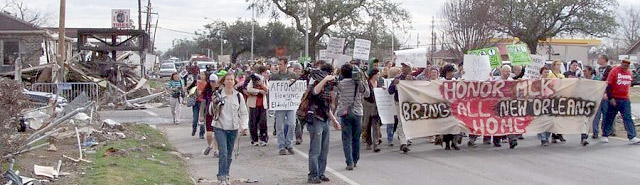
Tuesday, January 17, 2006 - T+4 months, 19 days:
The Los Angeles Times runs a long story on failure of the soil around the levees, not to mention failure of the government that was supposed to maintain them.
Typical:
Investigators recently told The Times that the 17th Street levee failed because its engineers made a series of crucial mistakes, one of which was to base the levee design on the average strength of the soil rather than on the strength of its weakest layer. The errors may reflect a loss of expertise during the 1990s, when the corps sharply downsized its soil laboratories.
The faulty soil analysis is one of many defects or flaws in concept, design, construction and maintenance that left many of the levees in New Orleans especially vulnerable to Katrina. Environmental miscalculations, including the loss of natural protection from marshes, added to the problems.
The errors might have been offset had the corps required larger safety margins, and that raises questions about the corps' internal culture.
(LA Times)
Tuesday, January 23, 2006 - T+4 months, 25 days:
Katrina becomes a hot media topic again, as investigations come to a head, FEMA deadlines for housing assistance approach, and things generally start to happen all at once.
First, Michael Brown (Loser #4) is interviewed by staff working for the Senate Homeland Security and Governmental Affairs Committee. Brown allegedly tells investigators that he was aware of FEMA's management problems caused by the move to DHS.
On a transcript, Brownie gives another of his great one-liners:
"What I wish I had done was, frankly, just either quit earlier or whatever and gone to certain friends that I can't talk about and said we got to fix this - I mean, what's going on is nuts."
(Associated Press)
Tuesday, January 23, 2006 - T+4 months, 25 days:
Sen. Joseph Lieberman and Rep. Henry Waxman, co-chairs of the joint Congressional committee, discover (from Brown's testimony and White House statements) that Bush intends to stonewall them for the usual executive privilege/ national security reasons. Lieberman says:
"There has been a near total lack of cooperation that has made it impossible, in my opinion, for us to do the thorough investigation that we have a responsibility to do."
He also threatens to subpoena the documents, and testimony from staff members.
The committee also releases documents indicating that FEMA was fully aware of Katrina's destructive potential, and had briefed everyone from the president on down. This obviously contradicts earlier statements that nobody had the slightest idea that the levees would break.
(NYT)
Tuesday, January 24, 2006 - T+4 months, 24 days:
Blanco announces that the postponed New Orleans city election will be held April 22. Along with Nagin, the sheriff, city assessor, and some of the council are up for re-election. Plans are in work for consolidated "mega-precincts" and a greatly expanded absentee ballot program, though nothing is final on either.
Wednesday, January 25, 2006 - T+4 months, 25 days:
From his temporary headquarters in a former nightclub, New Orleans District Attorney Eddie Jordan announces that a grand jury will look into several matters involving the police. These include the alleged car theft from the Cadillac dealer, the shootings on the Danziger Bridge, an out-of-town police chief and officer who were allegedly caught looting, and some sort of malfeasance by a Harbor Police officer.
Any charges in the car dealer matter would be in addition to an existing Federal grand jury indictment against a former police officer accused of stealing a pickup truck, and two civilians arrested in October.
Thursday, January 26, 2006 - T+4 months, 26 days:
Brown University sociologist John R. Logan releases his findings from a NSF-funded demographic research study in which he checked census figures against FEMA flood and wind damage maps. His data reinforces the common sense notion that African Americans took the brunt of Katrina, and will also be in the majority of those displaced.
According to Logan's findings, and absent a major rebuilding of neighborhoods, half the white population and only 20 per cent of the African American population would return to New Orleans, making a much smaller, richer, and whiter city.
Figures suggest that areas damaged by the storm were 75 per cent African American, compared with 46 per cent black in undamaged neighborhoods. 29 per cent of the households in damaged areas lived below the poverty line, compared with only 24 per cent in undamaged areas. (Associated Press)
Friday, January 27, 2006 - T+4 months, 2 days:
Andrew Rose and Loyd Hollman, the two officials in charge of the FEMA base camp in Algiers, are arrested by FBI and DHS special agents for allegedly shaking down contractors for bribes. One contractor was allegedly asked for $20,000 ($10,000 each) plus $2500 a week each in return for inflating meal billings submitted to the government. Federal Agents claim that they swept in and made the bust after two envelopes with the $10,000 were exchanged. (DOJ release quoted by US Newswire)
Tuesday, January 31, 2006 - T+5 months, 2 days:
U.S. District Judge Eldon Fallon grants class-action status to a lawsuit brought by residents of the area in St. Bernard Parish affected by the million-gallon spill at the Murphy Oil refinery during the storm.
Tuesday, January 31, 2006 - T+5 months, 2 days:
President Bush delivers a 58-minute State of the Union address to a joint session of Congress. Katrina gets six rather vague and platitudinous sentences near the end. (Transcript available at whitehouse.gov)
Wednesday, February 1, 2006 - T+5 months, 3 days:
Bush and Chertoff are accused of leadership and planning failures in the preliminary report of an investigation by the General Accounting Office. The report notes that there was never a clear chain of command within the administration. Chertoff in particular is criticized.
Spokespersons for the Department of Homeland Security react angrily to the report, calling it "a publicity stunt riddled with errors." (Associated Press)
Thursday, February 2, 2006 - T+5 months, 3 days, 20 hours, 20 minutes:
Severe thunderstorms hit the New Orleans area at 2:30 AM, causing two tornadoes. One hits Louis Armstrong International Airport in Kenner, tearing a temporary roof patch from a terminal building, destroying several jetways, and knocking out the power. Another destroys homes in the New Orleans Lakefront district that had been recently repaired from Katrina, and blows down a large radio tower. (Associated Press)
Tuesday, February 7, 2006 - T+5 months, 9 days:
4500 Katrina evacuees stuff their belongings into plastic bags and hit the street, after being evicted from hotel rooms in New Orleans and elsewhere on FEMA's cutoff date for funding their housing. An unknown (probably small) number become homeless. A state shelter only gets one family. (BET)
FEMA officials say that the evictions are caused by the failure of the evacuees to complete their paper work for requesting extensions. This is true, but most of the extensions are only for a week anyway.
An unknown person makes headlines by saying the rooms are needed for Mardi Gras. In New York and Oakland, demonstrators carry signs saying "EVICT FEMA."
Wednesday, February 8, 2006 - T+5 months, 10 days:
Lawyers for Michael Brown (Loser #4) respond to intense pressure from Senators by threatening that their client will reveal e-mail to the White House and FEMA, and testify fully before the investigating committee, "unless there is specific direction otherwise from the president, including an assurance the president will provide a legal defense to Mr. Brown if he refuses to testify."
Soon after, 1000 more e-mails become public, and the Senate committee establishes a comprehensive Katrina timeline. It is not particularly different from this one, written months earlier by yours truly, mostly from blogs, Google News, and Times-Picayune stories. Nice to know I was on the right track, though.
Wednesday, February 8, 2006 - T+5 months, 10 days:
Several hundred Katrina evacuees kick off two days of protest with a march in Washington, DC. Later, they attend a Congressional committee meeting, discussing the problems of slow relief and lost housing assistance with Democratic representatives. This is followed by a meeting between leaders and Brown's replacement at FEMA, and a candlelight vigil.
Thursday, February 9, 2006 - T+5 months, 11 days:
The New York Times writes an incredible report on the 800,000 pages of testimony to the committee by 250 witnesses. It contains such revelations as:
Friday, February 10, 2006 - T+5 months, 12 days:
Amazing story in the Los Angeles Times describes a situation where 10,770 empty FEMA trailers sit useless at an airport near Hope, AR. Since it is the rainy season, FEMA has plans to lay down 290 acres of gravel so they will not sink like Tarzan into the quicksand.
FEMA's story is that Federal flood regulations prevent the trailers being used in Louisiana, according to the Times.
Friday, February 10, 2006 - T+5 months, 12 days:
Brown makes good on his promise to tell all (covering his own butt, of course) when he testifies in person to the Senate committee. He answers questions all day, in a session that sometimes turns nasty.
Highlights:
"I find it a little disingenuous. For them [top officials] to claim that we didn’t have awareness of it is just baloney."
"[Natural disasters] had become the stepchild of the Department of Homeland Security. [Had there been a report that] a terrorist had blown up the 17th Street Canal levee, then everybody would have jumped all over that."
"There was a culture clash that didn’t recognize the absolute inherent science of preparing for a disaster."
Sunday, February 12, 2006 - T+5 months, 14 days:
The Washington Post and Associated Press leak some of the text of Wednesday's upcoming House investigation report.
Writes AP:
The 600-page report [...] found "fecklessness, flailing and organizational paralysis." Moreover, House investigators "are left scratching our heads at the range of clumsiness and ineptitude that characterized government behavior before and after this storm," the documents show.
Other issues:
Meanwhile, another GAO accounting report indicates massive government overpayment for housing, and a number of bureaucratic snafus involving the misuse of debit cards, messed-up disbursements, and those now-infamous trailers sinking ever deeper into the Arkansas mud.
Sunday, February 12, 2006 - T+5 months, 12 days:
Back in New Orleans, lawyers for evacuee groups file a request for a restraining order to stop the mass evictions planned for the 13th.
Monday, February 13, 2006 - T+5 months, 14 days:
U.S. District Judge Stanwood Duval denies the restraining order, allowing FEMA to stop paying the hotel bills as planned. It is not immediately known if any of the 12,000 affected families were actually evicted on the first day.
Wednesday, February 15, 2006 - T+5 months, 17 days:
Michael Chertoff gets his turn to give sworn testimony before the Senate Homeland Security and Governmental Affairs Committee. Since everything in Katrina is ironic, this is too, because it's his first anniversary as DHS secretary. Following this session, one starts to wonder if he will have a second one. He is hereby promoted to Loser #5.
Chertoff opens by disagreeing with Brown that DHS was too focused on terrorism, and proceeds to throw poor Brownie under the bus by describing a nasty dispute between the two officials regarding precise bureaucratic details of the National Response Plan. The result of this pissing contest is the rather dizzying revelation that, although Brown had eventually agreed to the plan, the two did not get along well, and Brown had been threatening to resign for quite some time. This might explain some of his e-mail, and perhaps his general attitude.
Chertoff goes on to claim that Brown considered his boss's phone calls irritating distractions. Indeed, it comes out that the two did not communicate effectively for two days after Katrina hit. (Transcript in Washington Post)
Chertoff also admits that he did not think that levees had breached, and that he was misinformed that there was overtopping only.
Other lowlights include:
"This lack of preparedness is evident throughout the response to Katrina. On August 30th, the day after Katrina made landfall, Secretary Chertoff named then FEMA Director Michael Brown as the principal federal official for the response effort. He did so despite Mr. Brown's hostility to the very concept of a principal federal official and his disdain for the national response plan. ... The effect of this delay was much like having the general show up after the battle had already begun." --Sen. Susan M. Collins (R-ME)
"But, Senators, but mothers and children are being thrown in the streets. Mothers and children are being thrown in the streets while trailers sit in the ground. This is not American. They're being evicted! They're being thrown on the ground!" --Male protester from the gallery
Saturday, February 18, 2006 - T+5 months, 20 days:
Official kickoff of the 2006 Mardi Gras season leading up to Fat Tuesday on February 28. Harrah's casino re-opens for the first time in nearly six months. The first parades in a shortened 8-day schedule are held in cold, rainy weather to reduced crowds, amid some controversy over whether the city is ready. However, people still seem to have a good time.
Fears of a completely commercialized and corporatized Mardi Gras fail to materialize. Nagin is only able to attract one such sponsor, the maker of Glad, which donates a large number of trash bags for post-parade debris. News reports mention parade beads being thrown, but not whether women braved the elements to get them in the traditional manner.
Monday, February 20, 2006 - T+5 months, 22 days:
Blanco announces the first draft of a $7.5 billion plan to rebuild, relocate, or buy out home owners. Assistance is capped at $150,000 per home owner, and the buyout would be at 60% of pre-storm value. Around $4.2 billion would come from Congress, but hasn't been appropriated yet. (Associated Press)
Thursday, February 23, 2006 - T+5 months, 25 days:
The White House issues its own report, a 228-page document entitled, The Federal Response to Hurricane Katrina: Lessons Learned. The introductory cover letter is signed by one Frances Fragos Townsend, Assistant to the President for Homeland Security and Counterterrorism.
The general thrust of the recommendations represents a further de-emphasis of FEMA for a disaster response that would be a mildly tweaked terrorism response, including active duty military and Federalization of the National Guard. Many of the recommendations seem barely relevant to hurricanes at all:
"DHS needs to establish a comprehensive list of skills and capabilities to assess how well citizens are prepared utilizing resources such as the Rand Corporations "Individual Preparedness and Response to Chemical, Radiological, Nuclear, and Biological Terrorist Attacks."" (Appendix A, Section 121, p.130)
All this makes one wonder if the White House and DHS are not planning a Global War on Severe Weather Systems.
Somewhat more relevant recommendations deal with the strengthening of national response plans, the establishment of a clear Incident Command System, and the integration of DoD and civilian assets under the IC and Joint Task Force systems. The development of highly mobile communication assets that can be quickly deployed or, better yet, pre-positioned is also recommended. (This is nothing the National Interagency Fire Center hasn't been doing for decades on forest fires, and come to think of it, Clinton's FEMA was getting better at this. Don't get me started.)
The entire document is available at whitehouse.gov.
Tuesday, February 28, 2006 - T+6 months, 1 day:
"Fat Tuesday" brings the annual blowout on Bourbon Street and the end of the Mardi Gras parade season. Crowds in the French Quarter are far below normal, though still enough to make a party atmosphere. Overall tourism is about one third normal.
Many of the Mardi Gras parades put on elsewhere in the city by the traditional krewes feature highly artistic floats and marchers who savagely satirize Bush, Brown, Chertoff, Nagin, Broussard, et al, thus making humor of the continuing dreadful situation. Blue tarps and MREs are common themes. One restaurant even puts an MRE on the menu - just fill out the necessary registration forms and it'll come in a week or so, if you're lucky.

Wednesday, March 1, 2006 - T+6 months, 2 days:
Associated Press obtains a video of the August 28 teleconference with Bush and various local, state, and federal officials. Despite the president's later declaration that "no one anticipated the breach of the levees," this possibility (as a result of overtopping) is clearly discussed by Mayfield and others on the video. In addition, Mayfield says that Katrina is going to be one of US history's great disasters, certainly "in the top 10 or 15." Brown worries that the Superdome may well become a "catastrophe within a catastrophe," and that insufficient efforts have been made to remove prisoners, patients, and tourists in hotels.
The president, who is sitting casually in Crawford, asks no questions during the teleconference, then he assures everyone that, "We are fully prepared."
Another teleconference video on the day of the storm contains the following remarkable statement by Brownie:
"I talked to the president twice today, once in Crawford and then again on Air Force One,. He's obviously watching the television a lot, and he had some questions about the Dome, he's asking questions about reports of breaches."
After the storm, someone was lying.
Later, an AP reporter catches up with Brown and asks him if he agrees with the Homeland Security statement to Congress that "the fog of war" prevented an effective response. He replies thusly:
"I don't buy the 'fog of war' defense. It was a fog of bureaucracy."
(Associated Press)
Wednesday, March 1, 2006 - T+6 months, 2 days:
6 month anniversary of Katrina hitting New Orleans.
Vast stretches of the city, not to mention parts of Mississippi, remain destroyed, with no visible plan for recovery. Just about all of the Lower Ninth Ward still lacks electricity, water, and gas. The cruise ships, which have been used as emergency housing and dining facilities, are taking to the sea. The eviction deadline has come and gone. The infamous trailers are dribbling in, but slowly.
Katrina refugees are beginning to wear out their welcome in Houston. The school district and most other Houston services have taken a financial hit, and no one's helping make it up. Baton Rouge is still a much larger city, perhaps permanently.
The Army Corps of Engineers is beginning demolitions again. Several homes in the middle of streets are being removed to allow access by construction workers. Estimates of the number of homes that will eventually need to be demolished range from 2500 to 25,000.
The latest conspiracy theory making the rounds is that the government deliberately kept help out of New Orleans as an experiment to see what would happen in a major terrorist attack.
Monday, March 13, 2006 - T+6 months, 15 days:
The beginning of the spring break season also starts a remarkable influx of student volunteers into New Orleans. These have been recruited on campuses nationwide by a number of organizations running a political gamut from Campus Crusade for Christ all the way to the Common Ground Collective.
While there is no easy way to get an accurate count, it is very likely that the total number of students working in New Orleans will reach well into the tens of thousands.
Tuesday, March 14, 2006 - T+6 months, 16 days:
Major march and rally by hundreds of Katrina refugees in Washington, DC. Speeches deal with the continued slow pace of reconstruction and a Congressional Black Caucus relief bill for LA, MS, and the TX diaspora, which is bottled up in committee.
Nagin and other candidates for mayor campaign in Texas, since that's where most of the voters are.
Monday, April 10, 2006 - T+7 months, 12 days:
Early voting begins in the April 22nd city election, bringing New Orleans issues back into the public spotlight. Satellite voting begins in a number of Louisiana cities, but not in other states, due to political maneuvering. News media report busloads of voters coming into LA to vote.
Nothing much has changed in a month. Poorer neighborhoods still lack many essential services, and insurance remains a big problem. Lawsuits ooze glacially through the legal system. Demolitions bog down, to the great relief of many, although this is due to lack of funds. Rents are higher in rebuilt buildings. Reports of people squatting in damaged buildings. The official rhetoric is to come on back and rebuild, but the money and will are not there to make this possible. Worse, the city's racial and economic divisions seem more intractable than ever.
One of the 22 mayoral candidates has an official campaign photo showing her in front of classic, French Quarter style buildings. Unfortunately, they are easily identifiable as the New Orleans Square in Disneyland.
Monday, April 10, 2006 - T+7 months, 12 days:
In Senate testimony, Lt. Gen. Carl Strock of the US Army Engineers finally admits that the levees had "design and construction flaws," and that their eventual replacements would be higher and generally beefier with deeper foundations and more reinforcement at the bottom of the cement wall.
Testimony from other witnesses also covers cost overruns and price gouging in the post-Katrina cleanup, noting lax enforcement and inefficiency stemming from the layers of subcontractors required to get anything done. Says Sen. Tom Coburn (R-OK):
"I'm certain we paid too much for debris removal; I'm certain we paid way too much for blue roofs; and I'm certain trailers cost two times as much as they should have... Is there a reason we should not have these contracts exposed to sunshine? For debris removal? Let me tell you that's something we're going to change."
Thursday, April 13, 2006 - T+7 months, 15 days:
FEMA finally issues guidelines for rebuilding structures in New Orleans. Homes will require a 3-foot elevation above ground, which many consider nowhere near enough. Strock notes again that the levees were flawed, though he assures that at least they will at least reach "pre-Katrina levels" in time for hurricane season to start in June. TV news shows repair work in progress on the east levee of the Industrial Canal, and drawings of flood gates to be installed on the canals to keep more of the surge out.
Friday, April 14, 2006 - T+7 months, 16 days:
A 200-page report by DHS inspector general Richard Skinner blames FEMA for poor performance in Katrina. The conclusions contain 38 recommendations for improving FEMA's effectiveness in areas ranging from housing for disaster victims to communicating with local officials.
Surprisingly, Skinner admits that FEMA's transition to Homeland Security has not been smooth, and will require "additional work and a level of support not currently demonstrated." There is also an admission that concern over terrorism allowed the neglect of natural disaster preparedness.
Friday, April 17, 2006 - T+7 months, 19 days:
The New Orleans Times-Picayune and the Biloxi Sun-Herald share the Pulitzer Prize in the public service category for their important reporting during Katrina. The Times-Picayune wins the breaking news prize outright. The Pulitzer committee praises the New Orleans paper for its "heroic, multi-faceted coverage," in the face of severe challenges such as the flooding of the newsroom and presses near the I-10, at which point the next three days' editions were published online.
Saturday, April 22, 2006 - T+7 months, 24 days:
The postponed New Orleans mayoral election is held, and with 91% of precincts counted, top vote-getter Ray Nagin enters a May 20 runoff with runner-up Mitch Landrieu, son of former mayor Moon Landrieu, the last white to serve in this position. Nagin leads Landrieu by about 10%, but Landrieu (currently lieutenant governor of LA) is the favorite to win the runoff after split voting blocs realign. Jesse Jackson has long since promised to challenge the election in court, regardless of its outcome, due to the lack of satellite voting outside Louisiana.
Wednesday, April 26, 2006 - T+7 months, 28 days:
The Senate Homeland Security and Governmental Affairs Committee delivers its final 800-page report, entitled "Hurricane Katrina: A Nation Still Unprepared." The most controversial part is a recommendation to dissolve FEMA as a "symbol of a bumbling bureaucracy" irrevocably broken by too many years of politics and mismanagement. The committee recommends creation of a new National Preparedness and Response Authority inside DHS, but with cabinet status. This draws immediate fire from both sides, as yet another bureaucratic reshuffling without addressing the larger failure of the entire Federal government.
This is not to say that the committee did not find plenty of blame to go around. The Blame Game ends in a draw. All our losers are represented.
Kathleen Blanco (Loser #1):
"...while Governor Blanco stated in a letter to President Bush two days before landfall that she anticipated the resources of the state would be overwhelmed, she made no specific request for assistance in evacuating the known tens of thousands of people without means of transportation... the state bears responsibility for not signaling its needs to the federal government more clearly."
Ray Nagin (Loser #2):
"...decided to open the Morial Convention Center as a second refuge of last resort inside the city, but did not supply it with food or water. Moreover, he communicated his decision to open the Convention Center to state and federal officials poorly, if at all. That failure, in addition to the delay of shipments due to security concerns and DHS’s own independent lack of awareness of the situation, contributed to the paucity of food, water, security or medical care..."
George Bush (Loser #3)
"...the President did not leave his Texas ranch to return to Washington until two days after landfall, and only then convened his Cabinet as well as a White House task force to oversee federal response efforts."
Michael Brown (Loser #4)
"...lacked the leadership skills that were needed. Before landfall, Brown did not direct the adequate pre-positioning of critical personnel and equipment, and willfully failed to communicate with Secretary Chertoff, to whom he was supposed to report."
Michael Chertoff (Loser #5)
"...should have been more engaged in preparations over the weekend before landfall. Secretary Chertoff made only top-level inquiries into the state of preparations, and accepted uncritically the reassurances he received. He did not appear to reach out to the other Cabinet Secretaries to make sure that they were readying their departments to provide whatever assistance DHS – and the people of the Gulf – might need."
FEMA:
...was unprepared for a catastrophic event of the scale of Katrina. Well before Katrina, FEMA’s relationships with state and local officials, once a strength, had been eroded in part because certain preparedness grant programs were transferred elsewhere in the Department of Homeland Security; not as important to state and local preparedness activities, FEMA’s effectiveness was diminished.
DHS:
"...failed to effectively lead the federal response to Hurricane Katrina. DHS leadership failed to bring a sense of urgency to the federal government’s preparation for Hurricane Katrina..."
DoD:
"...preparations were not sufficient for a storm of Katrina’s magnitude. Individual commanders [Good Guys #1-3] took actions that later helped improve the response, but these actions were not coordinated by the Department."
Wednesday, April 26, 2006 - T+7 months, 28 days:
Nagin, in an effort to improve his numbers going into the runoff, reverses his decision to ban FEMA trailer sites from New Orleans. However, the proposed one in Algiers that started the fuss (being next to an upscale gated community) remains in limbo. CNN runs a news story about someone who still has a shrimp boat stuck in the side of his house.
Wednesday, April 26, 2006 - T+7 months, 28 days:
New Orleans receives 1.2 inches of rain, which would be completely unremarkable except when three of the city's huge pumps burn out and must be taken offline for lengthy repairs. All three, at Lakeview, Gentilly, and Mid-City, have giant motors (one is 2500 horsepower!) which were damaged by salt water in Katrina. They will need a full rewinding by hand.
The failed pumps are at Lakeview, Gentilly, and Mid-City. The system remains 16% below its full capacity. (Times-Picayune)
Tuesday, May 2, 2006 - T+8 months, 4 days:
With hurricane season (not to mention the election) coming closer, Nagin announces the city's new disaster plan to maximum media attention. The major difference is the end of large buildings as "shelters of last resort." Instead, they will be transportation stations and staging areas. Amtrak trains will be used to help evacuate the city.
In a future evacuation, the call will come at the 30-hour mark, and Amtrak trains will be used along with buses and private cars in counterflow lanes to empty out the city. Nagin also advised everyone to have a personal hurricane plan in place - good idea.
Saturday, May 20, 2006 - T+8 months, 22 days:
Voting begins at various "super precincts" in the final New Orleans mayoral election.
News media are covering two coming reports on the US Army Corps of Engineers, one by an independent committee and one by the Corps itself. Leaked conclusions of the independent one depict standard US government dysfunction as usual at the USACE.
Saturday, May 20, 2006 - T+8 months, 22 days:
Ray Nagin is re-elected mayor of New Orleans. He wins with 52 per cent to Landrieu's 48.
Race becomes a factor in the election, after polarization following Nagin's "chocolate city" comment. Nagin, a one-time conservative businessman who formerly never received a free pass from New Orleans African-Americans, gets 80% of the black vote, plus a surprising 20% of whites.
The victory earns him a new term, and a chance at a revision of his current status, which remains at Loser #2. Time will tell.
Saturday, May 21, 2006 - T+8 months, 23 days:
The Louisiana state medical examiner raises the "official" Louisiana Katrina dead to 1577. According to Associated Press, several states receiving victims in the days immediately after the storm still have not reported, and the body count is far from finished.
Monday, May 22, 2006 - T+8 months, 24 days:
An ominous news conference at the National Hurricane Center outlines NOAA's dire prediction that the 2006 Atlantic hurricane season will once again be well above average.
The prediction is based on sea surface temperatures and general weather activity. It calls for 13 to 16 named storms, 8 to 10 of these becoming hurricanes, and 4 to 6 of those becoming major hurricanes, compared to an average of two.
Florida gives a pre-season sales tax break on hurricane supplies until June 1.
Monday, May 22, 2006 - T+8 months, 24 days:
Representatives from the independent UC Berkeley Civil Engineering Department investigation panel travel to Louisiana to brief the state legislature.
News media, including the Los Angeles and New York Times, run lengthy quotes and descriptions from the 600-page preliminary summary of what will be a 7000-page, peer-reviewed report to be released June 1. Most striking is the characterization of the US Army Corps of Engineers as dangerously underfunded and as a result losing compentency nationwide.
Highlights, according to civil engineering professor Raymond Seed and others:
Thursday, June 1, 2006 - T+9 months, 2 days:
First day of the "official" Atlantic hurricane season.
Ray Nagin is sworn in for his second term as mayor. The date was not chosen for this reason. That's just when New Orleans does it.
Predictions are for another worse-than-normal season. Nagin's second term may become interesting fast.
Thursday, June 8, 2006 - T+9 months, 9 days:
Times-Picayune reports that the New Orleans city water system still leaks 85 million gallons a day, compared to 50 million gallons used and paid for. Repairs to the system have actually lowered water pressure to a point where fire fighters have to use helicopter drops. The City Hall and municipal courthouse were forced to close early on Wednesday due to the low pressure.
Monday, June 12, 2006 - T+9 months, 14 days:
Rain begins in Florida as Tropical Storm Alberto moves closer to shore. The appearance of a named storm this early in the season indicates that conditions remain very active. Alberto comes close to hurricane force before dissipating over land. Damage is light, and the heavy rain puts out 18 wildfires in drought-plagued Florida.
"Some people note that the season's first storm has the same name as the US Attorney General, of "torture memo" fame."
Tuesday, June 13, 2006 - T+9 months, 15 days:
News media breathlessly report that $1.4 billion in FEMA storm aid to individuals was used for "questionable" purposes. These include 4 people who bought season tickets to the Saints, and one who spent it on a sex change.
Harder to find is a report that authorities have decided to demolish most public housing in New Orleans, and replace it not with newer and less filthy public housing, but instead with mixed-use developments attracting a higher average income. Rebuilding will take up to 3 years.
It is estimated that 1100 out of the former 5100 families living in public housing have returned to New Orleans.
Saturday, June 17, 2006 - T+9 months, 19 days:
New Orleans street crime becomes an issue again, after 5 people are machine-gunned in an apparent drug hit, and a 6th dies in an unrelated murder.
Nagin calls for a return of Army National Guard to the city for law enforcement purposes, and on Monday Blanco orders just that.
Saturday, July 15, 2006 - T+10 months, 17 days:
Disturbing news reports in the the Baton Rouge Advocate that residents of FEMA trailer parks are not allowed to talk to reporters unless they are escorted in by government personnel. According to the Advocate, a reporter was ordered out of a Morgan City trailer camp, and something similar happened in Plaquemines (which, nearly a year later, remains essentially destroyed). A FEMA source confirms that unsupervised media contact with residents is not allowed in its facilities.
The Advocate was researching a story on how "hundreds" of trailers still sit empty. Local politicians and national civil rights groups expressed alarm at the news.
Tuesday, July 18, 2006 - T+10 months, 20 days:
Louisiana charges a doctor and two nurses at Memorial Medical Center with second-degree homicide for allegedly euthanizing four patients after Katrina.
During the 4-day period in question, the hospital was without electricity or water, and 34 patients died before they could be moved elsewhere.
Monday, July 24, 2006 - T+10 months, 26 days:
The Department of Homeland Security announces that, due to the fraud encountered in Katrina and Rita, future emergency cash assistance after disasters would be limited to an almost insulting $500.
Wednesday, August 16, 2006 - T+11 months, 18 days:
Spike Lee's monumental new HBO documentary on Katrina's aftermath in New Orleans is premiered at the New Orleans Arena, next to the Superdome. It is called, "When the Levees Broke: A Requiem in Four Acts."
Monday, August 21, 2006 - T+11 months, 23 days:
Media kick off Katrina anniversary coverage early. HBO begins airing Spike Lee's documentary in four parts.
Another news story deals with a lawsuit filed by one of the people interviewed in the show, who is sueing authorities for causing the death of his mother by delaying relief to the thousands at the Convention Center. His story figures as prominently, and gut-wrenchingly, in the Lee documentary as her body did in the coverage of the unfolding tragedy at the time.
Friday, August 25, 2006 - T+11 months, 27 days:
One-year anniversary of Katrina's first landfall in south Florida. Massive media coverage of Katrina, with six new reports coming out timed to coincide with this obvious news hook.
As this is written, author Christopher Cooper is on the radio, plugging a book where he quotes sworn testimony to the Senate by a Gen. Matthew Broderick (!) regarding the initial fubar regarding information out of New Orleans. This testimony alleges that DHS/FEMA discounted Bahamonde's e-mail reports of levee breaches after Broderick saw people drinking beer in a dry French Quarter on CNN. Cooper asserts that Broderick, not having seen any pictures of floods, became the source of the "water over, not a breach" mail to Chertoff.
Media go to town on the unacceptable situation in New Orleans:
The 2006 hurricane season, while still slightly above average, is nowhere near as active as 2005 at the same time. Tropical storm Debbie is far out at sea, and Ernesto is predicted to come from a strengthening depression in the Caribbean.
Some information sources on the anniversary:
Saturday, August 26, 2006 - T+11 months, 28 days:
In a creepy anniversary deja vu, the first forecast path of 2006 Tropical Storm Ernesto has it aimed directly at New Orleans as a category 2 hurricane. Of course, uncertainty is extremely high here.
Sunday, August 27, 2006 - T+11 months, 29 days:
Large sigh of relief as new Ernesto predictions, still highly uncertain, show a curve away from New Orleans.
Monday, August 28, 2006 - T+11 months, 30 days:
Large sigh of resignation as president bush reaches New Orleans for dinner and photo ops. Said the pres: "The people want to succeed, and our job at the federal level is to help you to succeed. That is what I have come to tell you."
He's lying:
From One Year after Katrina, Gulf Coast Reconstruction Watch/Institute for Southern Studies, August 2006.
Monday, August 28, 2006 - T+11 months, 30 days:
Local politicians and media are punk'd big time by a hoax press conference in Kenner, where members of a prankster group called the Yes Men impersonated HUD officials announcing a plan to rebuild public housing after all. CNN is especially slow catching on, after a morning of breathless coverage.
Tuesday, August 29, 2006 - T+ONE YEAR:
It is now a year since Hurricane Katrina initiated the series of related events that led to the near-total destruction of a vast section of the Gulf Coast, including but not limited to the city of New Orleans.
In this intervening 365 days, billions of words have been spoken and written. Uncountable terabytes of data have churned through American computers. Many thousands of hours have been spent in hearings, investigations, deliberation, testimony, and yes, the production of hundreds of extensively researched timelines just like this one.
For a year now, we've all chuckled darkly at the ever-growing lists of Katrina quotes circulating the Internet. These are indeed humorous, as they reveal the utter cluelessness of nearly everyone we've elevated as a leader, pundit, or role model. But we're whistling past the graveyard here, and we know it, because we haven't the slightest notion of how to put the world right again.
At this point, we're just starting to get it. It's just now dawning on us that Katrina revealed how miraculously we've resurrected social Darwinism from history's ideological boneyard of truly dumb ideas. We know this because, from the very start, the New Orleans underclass has been on its own. Sometimes New Orleans has been treated more like a plantation. Other times, it's been touted as The Conservative Laboratory for privatized recovery. Given the utter hypocrisy of this non-recovery, in which people can't even get jobs rebuilding their own neighborhoods, and where an entire American social class has even less right of return than Palestinians half a world away, it's looking a lot more as if the laboratory has blown up.
This explosion's economic and social effects are incalculable. Katrina's diaspora, the largest displaced population in US history, remains at a staggering 500,000. Baton Rouge is still the biggest city in Louisiana. Houston is beginning to tire of high crime and financial drain. Whole huge neighborhoods are no closer to recovery than they were a year ago. Thousands still live day to day in FEMA trailers.
It strongly appears that the real enemy of the United States is its short attention span. Nothing lasts. Perhaps we've just been too mentally worked over by television to sustain the kind of committment a Katrina-size disaster requires. Too bad for us.
Will Katrina's lessons, then, vanish down the post-modern memetic sewer along with everything else? Will we just keep blundering and blustering along like a bunch of self-righteous global Keystone Kops? Will our imaginary best of all possible worlds sit blindly in wait, leading inevitably and depressingly to a dreary repeat of this tragedy somewhere else, followed by another brief yet fruitless round of soul-searching, blame-shifting, and politicking? Will we need to write yet another set of preachy timelines on the Internet? Are these, along with blogs, the real journalism of the neocon era?
I suspect the answers are being written in turbulent Atlantic air masses even as we count days since Katrina.
Tuesday, August 29, 2006 - T+ONE YEAR:
New Orleans marks the first anniversary. President bush (Loser #3) meets conservative African American mayor Ray Nagin (Loser #2) for breakfast and photo op at Betsy's Pancake House. Waitress Joyce Labruzzo asks the president if he's going to turn his back on her again. He answers in the negative, as everyone laughs. They then traipse over to St. Louis Cathedral, in one of the few places that stayed above water, to meet Governor Blanco (Loser #1) and begin a busy day of prayer and photography. Outside the camera frame at one stop are several piles of rubble and a busted toilet laying on its side.
Brownie (Loser #4) takes another long, nasty blast at his old boss (Loser #5), indicating that the blame game is not quite over yet.
A sad jazz procession winds through the city, and bells toll at the estimated time of a levee break. Gen. Honore (Good Guy #2) is Grand Marshal of a parade. 500 news personnel use a media center at the Sheraton on Canal St.. WWL does a live remote from there, which is also shown on C-SPAN. It's good TV. We watch a radio talk show being made, as Garland Robinette takes calls from everywhere, and interviews everyone from the president on down.
Tropical Storm Ernesto takes a bead on south Florida, as warnings are posted all the way to Georgia. The space shuttle is moved back into its assembly building.
Wednesday, August 29, 2007 - T+TWO YEARS:
Reread everything above for the one year anniversary. Nothing has changed. Deja vu all over again. Let's do the time warp again.
This is unsettling. Nothing's any different. The same people are on the same shows saying the same things. The president traipses through the ruins, oblivious to anything outside his constricted and disconnected little world. He praises great steps that only exist for the wealthy few, ignoring the tens of thousands of people still in refugee camps by any other name.
Meanwhile, the Ninth Ward still sits and rots, growing mold but not much else. People's possessions still lie where the floods left them, all turning the same uniform brownish color. No one comes to get them. They can't. Their owners have been "disappeared." Some still live, incommunicado, in FEMA trailers, which were recently shown to contain toxic levels of gases. Others are simply gone, their whereabouts known only to community activists, or to no one at all.
There can be no more doubt that the poor of New Orleans have been dealt with by simple abandonment. This is post-modern internal warfare at its most chilling, where power structures simply leave communities to decay into an uninhabitable state, at which point the population is dispersed to latter-day gulags.
At one time, armies with guns would clear out parts of cities deemed undesirable to the ethnic or religious groups running things. Now, the people in power kill by neglect, gradually withdrawing services (in this case safe levees and coherent emergency plans), until total collapse ensues. In the United States, such communities are nearly always of color. This is called racism.
The situation in New Orleans is worse than bureaucratic incompetence. Much worse. It's ethnic cleansing, and it's un-American. Who will save our country?
Wednesday, August 27, 2008 - T+2 Years, 11 months, 29 days:
Governor Jindal of Louisiana (who replaced Loser #1, and is not a loser at all) declares a state of emergency and puts National Guard on alert, when long term predictions show Tropical Storm Gustav becoming a major hurricane hitting New Orleans sometime over the Labor Day weekend. Ray Nagin (ex-Loser #2) leaves the Democratic National Convention, and says that he will order an evacuation of the city if the predictions firm up as a category 3 or greater. Jindal promises 700 buses will be available as early as Friday as needed. City emergency manager Jerry Sneed promised that Amtrak could evacuate 7000 people on special trains.
Since the Ninth Ward and St. Bernard Parish are still largely in ruins and abandoned, the housing projects are gone, and most of the poor have vanished even from FEMA's toxic trailers, the evacuation (if needed) should go better this time.
Friday, August 29, 2008 - T+THREE YEARS:
Three years, and everything is pretty much like two years, which was pretty much like one year. The levees are a bit better than before Katrina, but not great. Only 20% of planned work has been done, and 3/4 of the money allocated to this upgrade has not been spent. US Army Corps of Engineers hurriedly reinforces 1800 feet of the Industrial Canal. Promised flood gates in the canal remain unfinished. In other areas devastated by Katrina and Rita, various projects remain equally unfinished, and many communities have been slow rebuilding.
Despite brave rhetoric, slow insurance payments and other bureaucratic hangups continue to hamper recovery. Away from the touristy French Quarter, which after all largely survived Katrina, many streets are still in ruins. Ironically, one of the worst is Flood Street. The Quarter itself spent most of August dealing with a major oil spill when a tanker hit a barge right under the Crescent City Connection. The case against the officers involved in the Danziger Bridge shootings has been thrown out on technicalities relating to improper Grand Jury procedures.
The official third anniversary observance in New Orleans is overshadowed by a continuing possibility of mass hurricane evacuation. Nagin advises people to begin emergency preparations, and watch for any mandatory evacuation warnings. National Hurricane Center predictions, while highly uncertain, still show a Gustav landfall as a category 3 or higher, at an unknown point probably southwest of New Orleans. Many are dead in Jamaica and Haiti. Resorts in the Cayman Islands are closed, and tourists are taken off by plane. Ominously, another tropical storm (Hanna) forms in the Atlantic, and two other disturbances line up clear back to Africa.
Since 2008 is an election year, massive emergency preparations continue in Louisiana. 1/4 of the Louisiana National Guard is mobilized for possible use in New Orleans. Buses are driven to parking lots in the city for possible use. Sneed warns that no shelters such as the ill-fated Astrodome will be available, so people that "have no means" (his words, making it sound like a disease) will need to get on a bus and go wherever the driver is told to go. Prisoners are already being bused out (and they can't choose where they're going either). The Recovery School District cancels school, and presumably recovery, on Tuesday and Wednesday. Gun and ammo sales pick up.
Doesn't seem like much changes........
Sunday, August 31, 2008 - T+3 years, two days:
Gustav briefly reaches category 4, and it picks up speed over the open Gulf. Nagin orders a mandatory evacuation of New Orleans for 8 AM Sunday. Media report lines "a mile long" for buses out. 30,000 are expected to reach shelters in other states by bus. I-10 is made into a one way street, and it backs up for miles. Motels fill up all the way to Oklahoma. City officials, perhaps in an effort to convince people to leave, make predictions so grim as to defy belief. Nagin says that it is worse than Katrina. Police Superintendent Warren Riley is quoted by the New York Daily news as saying, "This could be the most horrific thing that ever happens in this country."
Sunday, August 31, 2008, 12:10 PM - T+3 years, two days, 6 hours:
Jefferson Parish President Aaron Broussard (remember him?) calls the first mandatory evacuation of both east and west banks in the history of Jefferson Parish. In New Orleans, Nagin warns that looters will be taken directly to prison. The entire region goes under a total curfew at dusk, with no one allowed on the streets. Nagin also warns that remining FEMA trailers in the area are likely to be picked up by wind and become projectiles.
George Bush (then, now, and forever Loser #3) and Dick Cheney both cancel plans to speak at the Republican National Convention. John McCain breathes a major sigh of relief to be rid of those two political millstones. Bush flies to Texas to be nearer the situation. Coincidentally enough, this just happens to be the location of his ranch, where he'd have gone over Labor Day anyway had it not been for the convention.
Monday, September 1, 2008, 12:10 PM - T+3 years, three days:
Gustav's center misses New Orleans to the south and west, perfectly matching the path predicted days before by the National Hurricane Center. New Orleans escapes major damage. The new flood gates in the 17th Street and London Avenue Canals are closed, and they do the job. Water overtops the Industrial Canal, where the gates haven't been installed yet, leading to minor flooding in the immediate area. This recedes quickly. Level in the canal itself lowers more slowly when a drawbridge accidentally left down cannot be raised because its controls are under water. Three errant barges and one decommissioned Navy ship come to rest against this bridge. Gen. Honore (forever Good Guy #2) now works on-camera for CNN. He mentions that we've just learned that we need to tow these barges out of town next time. Honore does a great job, suggesting a possible future career.
As the storm moves out, it becomes evident that Grand Isle is completely under water, and lightly populated parishes to the southwest of the city are badly damaged. Gustav continues inland as a low category 1, damaging Baton Rouge and threatening Shreveport. All in all, however, government preparations and timely hurricane measures seem to have greatly paid off in reduced loss of life and increased storm response. One is left with the idea that we actually have learned something from Katrina, or at least with the hope that all major hurricanes will happen in election years.
Wednesday, November 18, 2009 - T+4 years, 2.5 months:
Judge Stanwood Duval rules in favor of 4 plaintiffs who had sued the US government for damages after what they alleged was negligent operation of the MR-GO, exacerbating flood destruction in the Lower Ninth Ward and St. Bernard Parish. Duval awards $700,000 in damages. He sides with lawyers who used a computer simulation of the MRGO flooding to show the effects of bad maintenance by the US Army Corps of Engineers, allowing the canal to deteriorate and become more hazardous.
This case opens up the possibility of a massive class action suit, which would force the government to pay out billions in damages to people affected by the flooding. The US Army Corps of Engineers has 50 days to file an appeal, and further litigation is a strong possibility.
Wednesday, February 24, 2010 - T+4 years, 6 months:
Nearly five years later, a New Orleans cop finally puts the story straight on the Danziger Bridge shootings. Michael Lohman, a former NOPD lieutenant, pleaded guilty on a federal charge of conspiracy to obstruct justice by instigating a massive cover-up of police misconduct that caused two deaths.
Lohman admits that, upon arriving on the scene, he found an unjustified police shooting. Further, he says that he arranged cover stories and statements for the involved officers, and even had a weapon planted on the scene so it would appear that the civilians fired first.
As federal investigations continue, further scandals are inevitable. These will be quite striking, even in a city famous for same.
Sunday, August 29, 2010 - T+FIVE YEARS:
The five-year anniversary brings out a media feeding frenzy, climaxing in another president giving yet another speech in New Orleans.
So what has really happened here? The Army is rebuilding the levees, and says they absolutely positively definitely will hold up to a category 3 THIS time. The Saints won the Super Bowl. The cops fessed up on the Danziger Bridge. We are told there is much reason for hope.
Is there really? The answer seems to be an Inverse Yes Effect. Hope seems to diminish with the square of the distance from the French Quarter. Tourists pack Bourbon St. bars and the party is back, but out in the Ninth Ward there are still vast stretches of uninhabited nothing. Even up in the rich neighborhoods near Ponchartrain, many homes are still gone. There's still a New Orleans Diaspora. Many still want to come home. Will they ever?
And then you get to the southern parishes, the ones that were wiped out when entire stretches of levees failed. It had been said, over and over again, that 2010 was going to be a good year, where many people finally got their lives back together. That, however, was before a British oil company with a Swiss contractor blew up a deep-water well intended for Chinese trade. Again came the media, the promises, and the political posturing. Again came the narrative of unkept promises and money that never seemed to get to where it was needed. In other words, a LOT of people who had finally gotten onto their feet were quickly and brutally beaten right back down. It makes one cry.
This latest destruction of hope has moved one local intellectual to wonder if the south of Louisiana has simply fallen off the United States. He asks whether it is now a social and political colony, left to itself, dismissed as a place where life is cheap, and really not thought about much at all unless there's a potential commercial profit to be made by plutocrats in some other country.
Finally, we come to the baddest of the Katrina bad guys: Mister Go. It's the misbegotten Mississippi River/ Gulf Outlet built largely for tankers and oil barges, over the objections of just about everyone else, and then rarely even used by them. That crumbling, eroding, useless waterway served mostly to destroy valuable wetlands, turn Lake Ponchartrain into a dead zone, and channel surge directly into New Orleans -- exactly as predicted. It's the reason why a court of law ruled Katrina a man made disaster, making the USACE liable for much of it.
A couple of years after Katrina, Congress ordered the damn thing closed. USACE has subsequently withdrawn it from navigation, and plugged it with a narrow dam. But Mister Go won't be gone until the rest of the remedial work is done. It is years behind schedule. Just like everything else in the United States. Even the wars.
This timeline began as a simple attempt to unravel the various levee failures, establishing what happened when. However, a clear subtext emerged almost instantly, and that's when the narrative presented here became a Magnum Opus. It reveals, with painful clarity, absolute proof of a total breakdown in all levels of government. No one is excluded, no blame can be shifted, and no party can be excused. Only a few military units ever really had it together, and this does NOT include the previously respected US Army Corps of Engineers. All of this forced us to learn only one lesson, and draw only one conclusion: We had to do better than this.
Much has actually improved in five years. However, after all the sound, fury, suffering, drama, investigation, fear, expense, and agony, the lesson remains clearer than ever: We still have to do better than this.
Wednesday, December 1, 2010 - T+5 years, 3 months:
Former New Orleans police officer Michael Hunter, a white man, is sentenced to the maximum of eight years in prison for his role in the Danziger Bridge shootings. Hunter had offered the defense that, while he shot at the unarmed African-Americans, he didn't hit anything. While his lousy aim kept him from a murder charge, the judge was not amused. However, Hunter has reportedly been offered time off if he testifies against the other cops who are coming to trial.
Friday, August 5, 2011 - T+5 years, 11 months:
Five more former New Orleans police officers are convicted on Federal charges in the Danziger Bridge shootings. Robert Faulcon, Robert Gisevius, Kenneth Bowen, and Anthony Villavaso are found guilty for the cover-up and for civil rights violations resulting in death. Arthur Kaufman, who was appointed later to investigate, was found guilty for the cover-up only. The first four ex-cops could get life in prison. Sentencing is in December.
Wednesday, August 29, 2012 - T+7 years -- exactly:
The exact moment of the Katrina "anniversary" comes with yet another election-year hurricane, Isaac, parked over southern Louisiana. Plaquemines Parish, whose old levees were outside the New Orleans rebuilding program, has 18 miles of overtopping and many rescues by the National Guard. The president of Plaquemines calls it "worse than Katrina." Storm chasers with satellite video tweet links to live feeds showing low lying areas near the Mississippi coast and the lake under water. Contrast this information explosion with the almost total lack of communication in Katrina, where two yutzes hunkered down in windowless spaces with Blackberries were just about it. Nor does it hurt that, once again, there's an election coming soon, requiring politicians to look busy.
While things are obviously moving in a good direction, nagging issues remain over climate change, economics, and excessive partisanship on both sides of the aisle.
We still have to do better than this.
# # #
Appendix #1: Map of New Orleans
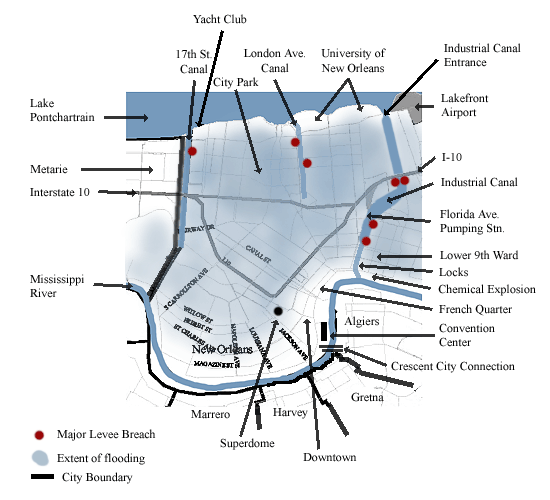
Appendix #2: Memorable Quotations
The Thoughts of Aaron Broussard:
[Ed. note: Aaron Broussard, president of Jefferson Parish, gained wide sympathy for Louisiana's plight with his interviews on various Sunday pundit shows. However, he is controversial back home, where many question various decisions he made before Katrina hit. In addition, the famous and heartbreaking story about a staffer's drowned mother is omitted because it appears highly unlikely that it happened that way. It now seems more likely that in fact she perished in the St. Rita's Nursing Home debacle. See Wikipedia for more.]
"Say goodbye to the Jetsons. We're back to the Flintstones."
-- Newsday.com
"And whoever is at the top of this totem pole, that totem pole needs to be chain-sawed off and we've got to start with some new leadership."
--Face the Nation, 9/4
"We have been abandoned by our own country. Hurricane Katrina will go down in history as one of the worst storms ever to hit an American coast, but the aftermath of Hurricane Katrina will go down as one of the worst abandonments of Americans on American soil ever in U.S. history."
--Face the Nation, 9/4
"Take whatever idiot they have at the top of whatever agency and give me a better idiot. Give me a caring idiot. Give me a sensitive idiot. Just don't give me the same idiot."
--Face the Nation, 9/4
"Nobody's coming to get us. Nobody's coming to get us. The secretary has promised. Everybody's promised. They've had press conferences. I'm sick of the press conferences. For God sakes, shut up and send us somebody."
--Face the Nation, 9/4
"Yesterday--yesterday--FEMA comes in and cuts all of our emergency communication lines. They cut them without notice. Our sheriff, Harry Lee, goes back in, he reconnects the line. He posts armed guards on our line and says, 'No one is getting near these lines.'"
--Face the Nation, 9/4
The Wisdom of Our Leaders:
"I'm mindful of what goes on around me. On the other hand, I'm also mindful that I've got a life to live, and will do so."
--Bush, on vacation in Crawford, TX, 8/25/05 (day of Katrina's first landfall in FL)
"What didn't go right?"
--Bush (to Pelosi, quoted in USA Today)
"I don't think anybody anticipated the breach of the levees."
--Bush (Good Morning America, 9/1/05, Quoted by Media Matters)
"Brownie, you're doing a heck of a job."
--Bush, to media at a photo op, 9/2/05
"What I'm hearing, which is sort of scary, is they all want to stay in Texas. Everyone is so overwhelmed by the hospitality. And so many of the people in the arena here, you know, (chuckles) were underprivileged anyway, so this is working very well for them."
--Barbara Bush (NPR Marketplace, quoted by AP and CNN)
"I also want to encourage anybody who was affected by Hurricane Corina [sic] to make sure their children are in school."
--Laura Bush, Mississippi photo op, 9/5/05 (video here)
"I have not heard a report of thousands of people in the convention center who don't have food and water."
--Michael Chertoff, on NPR "All Things Considered," 9/1/05
"We just learned of the convention center - we being the federal government - today."
--Michael Chertoff (later on 9/1, to Ted Koppel on "Nightline")
"Louisiana is a city that is largely underwater..."
--Michael Chertoff, press conference 9/3/05 (quoted by Atrios)
"Now tell me the truth boys, is this kind of fun?"
--Former House Majority Leader Tom "The Hammer" DeLay, to evacuees at the Astrodome (quoted on Houston Chronicle's DomeBlog)
"You come in our city, you're going to have a gun in your face. Just the way it is."
Ben Morris, mayor of Slidell, LA, to CNN on 9/14
"They [FEMA] have turned away generators, we've heard that they've gone around seizing equipment from our contractors. If they do so, they'd better be armed because I'll be damned if I'm going to let them deprive our citizens. I'm pissed off, and tired of this horseshit."
--Ben Morris, mayor of Slidell, LA
"They flew down here one time, two days after the doggone event was over. Excuse my French, everybody in America, but I am pissed!"
--Ray Nagin, Mayor of New Orleans
Praise the Lord:
"New Orleans now is abortion-free. New Orleans now is Mardi Gras-free. New Orleans now is free of Southern decadence and the sodomites, the witchcraft workers, false religion--it's free of all of those things now. God simply, I believe, in His mercy purged all of that stuff out of there--and now we're going to start over again."
--The Rev. Bill Shanks, pastor of New Covenant Fellowship of New Orleans (Statement 9/2/05, quoted in The Nation)
"THEY DESERVED KATRINA"
--Sign on New England Baptist Church, Medford, MA
"We finally cleaned up public housing in New Orleans. We couldn't do it, but God did."
--Rep. Richard Baker (Republican, LA-6, quoted in Wall St, Journal, reprinted on RawStory)
"New Orleans and the Gulf Coast have always been known for sin and wickedness. And why are we surprised the hand of judgment fell? I think the Lord sent them a message that they'd better turn around or they'll have another hurricane coming."
--Alabama State Senator Hank Irwin
"New Orleans is the first of the cities going to tumble down... unless America changes its course... It is the wickedness of the people of America and the government of America that is bringing the wrath of God down"
--Louis Farrakhan, Philadelphia, 9/4/05
"We need a prayer that's walking and not just talking. We need a prayer with legs right now."
-- Rev Enoch Fuzz, president, TN Interdenominational Ministers Fellowship, on bush's national day of prayer (quoted by BBC News http://news.bbc.co.uk/2/hi/americas/4253040.stm )
The Fourth Estate:
"I just wish Katrina had only hit the United Nations building, nothing else, just had flooded them out. And I wouldn't have rescued them."
--Bill O'Reilly, on The Radio Factor, 9/14 (Quoted by Media Matters http://mediamatters.org/items/200509160007)
"There are corpses in the street being eaten by rats and this is the United States of America."
--Anderson Cooper, on CNN
"Hurricane Katrina is George Bush's Monica Lewinsky. The only difference is that tens of thousands of people weren't stranded in Monica Lewinsky's vagina."
--Jon Stewart, The Daily Show
"Herbert Hoover was a shitty president, but even he never conceded an entire city to rising water and snakes. On your watch, we've lost almost all of our allies, the surplus, four airliners, two trade centers, a piece of the Pentagon and the City of New Orleans. Maybe you're just not lucky."
--Bill Maher
Reporting For Duty, Sir:
"She wouldn't know the 82nd Airborne from the Harlem Boys' Choir."
--Anonymous Blanco employee (Newsweek, 9/13/05)
"This is f***ing unbelievable. We were given an operations order to herd our fellow New Orleanians onto buses like cattle or convicts in the middle of the night. They weren't even allowed to pick up their belongings. We were responsible to inventory their stuff and bag it up."
--Anonymous LA National Guard (Huffington Post, 2/10/06)
Just A Phone Call Away...
"Want to gab with the sluttiest girls your nasty imagination can dream up? Mmmm...we can be whatever you want us to be, baby. After all, it is your fantasy..."
--Voice on phone sex number given by KY governor's office for the Red Cross (Kos)
"You have reached the Federal Emergency Management Agency. Because Hurricane Katrina has affected so many people, all of our agents are busy assisting other callers. We apologize for this inconvenience. Your call will be disconnected. Please call again later. (Click)"
--FEMA telephone answering message (studio callouts by several hosts on Air America)
Appendix #3: New Orleans NWS Special Advisory 8/28
623
WWUS74 KLIX 282139
NPWLIX

URGENT - WEATHER MESSAGE
NATIONAL WEATHER SERVICE NEW ORLEANS LA
413 PM CDT SUN AUG 28 2005

...EXTREMELY DANGEROUS HURRICANE KATRINA CONTINUES TO APPROACH THE
   MISSISSIPPI RIVER DELTA...
..DEVASTATING DAMAGE EXPECTED

MOST OF THE AREA WILL BE UNINHABITABLE FOR WEEKS...PERHAPS LONGER. AT
LEAST ONE HALF OF WELL CONSTRUCTED HOMES WILL HAVE ROOF AND WALL
FAILURE. ALL GABLED ROOFS WILL FAIL...LEAVING THOSE HOMES SEVERELY
DAMAGED OR DESTROYED.

THE MAJORITY OF INDUSTRIAL BUILDINGS WILL BECOME NON FUNCTIONAL.
PARTIAL TO COMPLETE WALL AND ROOF FAILURE IS EXPECTED. ALL WOOD
FRAMED LOW RISING APARTMENT BUILDINGS WILL BE DESTROYED. CONCRETE
BLOCK LOW RISE APARTMENTS WILL SUSTAIN MAJOR DAMAGE...INCLUDING SOME
WALL AND ROOF FAILURE.

HIGH RISE OFFICE AND APARTMENT BUILDINGS WILL SWAY DANGEROUSLY...A
FEW TO THE POINT OF TOTAL COLLAPSE. ALL WINDOWS WILL BLOW OUT.

AIRBORNE DEBRIS WILL BE WIDESPREAD...AND MAY INCLUDE HEAVY ITEMS SUCH
AS HOUSEHOLD APPLIANCES AND EVEN LIGHT VEHICLES. SPORT UTILITY
VEHICLES AND LIGHT TRUCKS WILL BE MOVED. THE BLOWN DEBRIS WILL CREATE
ADDITIONAL DESTRUCTION. PERSONS...PETS...AND LIVESTOCK EXPOSED TO THE
WINDS WILL FACE CERTAIN DEATH IF STRUCK.

POWER OUTAGES WILL LAST FOR WEEKS...AS MOST POWER POLES WILL BE DOWN
AND TRANSFORMERS DESTROYED. WATER SHORTAGES WILL MAKE HUMAN SUFFERING
INCREDIBLE BY MODERN STANDARDS.

THE VAST MAJORITY OF NATIVE TREES WILL BE SNAPPED OR UPROOTED. ONLY
THE HEARTIEST WILL REMAIN STANDING...BUT BE TOTALLY DEFOLIATED. FEW
CROPS WILL REMAIN. LIVESTOCK LEFT EXPOSED TO THE WINDS WILL BE
KILLED.

AN INLAND HURRICANE WIND WATCH IS ISSUED WHEN SUSTAINED WINDS NEAR
HURRICANE FORCE...OR FREQUENT GUSTS AT OR ABOVE HURRICANE FORCE...ARE
POSSIBLE WITHIN THE NEXT 24 TO 36 HOURS.

LAZ038-040-050-056>070-MSZ080>082-290300-
ASSUMPTION-HANCOCK-HARRISON-JACKSON-LIVINGSTON-LOWER JEFFERSON-
LOWER LAFOURCHE-LOWER PLAQUEMINES-LOWER ST. BERNARD-LOWER TERREBONNE-
ORLEANS-ST. CHARLES-ST. JAMES-ST. JOHN THE BAPTIST-ST. TAMMANY-
TANGIPAHOA-UPPER JEFFERSON-UPPER LAFOURCHE-UPPER PLAQUEMINES-
UPPER ST. BERNARD-UPPER TERREBONNE-
413 PM CDT SUN AUG 28 2005

..INLAND HURRICANE WIND WARNING IS IN EFFECT

HURRICANE KATRINA CONTINUES TO APPROACH THE AREA. TROPICAL STORM
FORCE WINDS ARE CURRENTLY MOVING INTO THE COASTAL MARSHES AND WILL
PERSIST FOR THE NEXT 26 TO 28 HOURS. HURRICANE FORCE WINDS WILL
ONSET AROUND MIDNIGHT NEAR THE COAST AND BY 3 AM CLOSER TO THE NEW
ORLEANS METRO AREA AND PERSIST FOR 9 TO 15 HOURS. MAXIMUM WIND GUSTS
AROUND 175 MPH ARE LIKELY IN THE WARNED AREA BY DAYBREAK MONDAY.

DO NOT VENTURE OUTDOORS ONCE TROPICAL STORM FORCE WINDS ONSET!


LAZ034>037-039-046>049-MSZ068>071-077-290300-
AMITE-ASCENSION-EAST BATON ROUGE-EAST FELICIANA-IBERVILLE-
PEARL RIVER-PIKE-POINTE COUPEE-ST. HELENA-WALTHALL-WASHINGTON-
WEST BATON ROUGE-WEST FELICIANA-WILKINSON-
413 PM CDT SUN AUG 28 2005

..INLAND HURRICANE WIND WARNING IS IN EFFECT

HURRICANE KATRINA CONTINUES TO APPROACH THE AREA. TROPICAL STORM
FORCE WINDS ARE CURRENTLY MOVING INTO THE COASTAL MARSHES AND WILL
SREAD NORTHWESTWARD INTO THE GREATER BATON ROUGE AREA AND
SOUTHWEST MISSISSIPPI LATER THIS EVENING. TROPICAL STORM FORCE
WINDS ARE EXPECTED TO ONSET AROUND 9 PM TONIGHT AND PERSIST
FOR 22 TO 26 HOURS. HURRICANE FORCE WINDS WILL ONSET AROUND
DAYBREAK AND PERSIST FOR ABOUT 5 TO 10 HOURS. MAXIMUM WIND
GUSTS OF 80 TO 90 MPH ARE POSSIBLE IN EAST-CENTRAL LOUISIANA
AND SOUTHWEST MISSISSIPPI.

DO NOT VENTURE OUTDOORS ONCE TROPICAL STORM FORCE WINDS ONSET!